
I found myself thinking about this while attending the Viking Congress in Oslo this summer. The Congress brings together archaeologists, historians, philologists and other scholars working on the Viking Age and the wider Scandinavian world. However, there were no actual Vikings I’m afraid! Despite that disappointment, there were excellent discussions focused on mobility, settlement, identity and cultural interaction, and they brought me back to a question that has long bothered me: how did the Pictish societies of Orkney and Shetland actually become Norse?
It sounds straightforward, but it is surprisingly difficult to answer. We know the end of the story much better than the beginning. By the central Middle Ages, Orkney and Shetland were overwhelmingly Norse-speaking societies, closely connected politically, culturally and linguistically with Norway and the wider Scandinavian North Atlantic. Their place-names are overwhelmingly Norse. Before the Viking Age, however, the islands belonged to a Pictish and Insular Christian world. Somewhere between those two points something very profound happened.
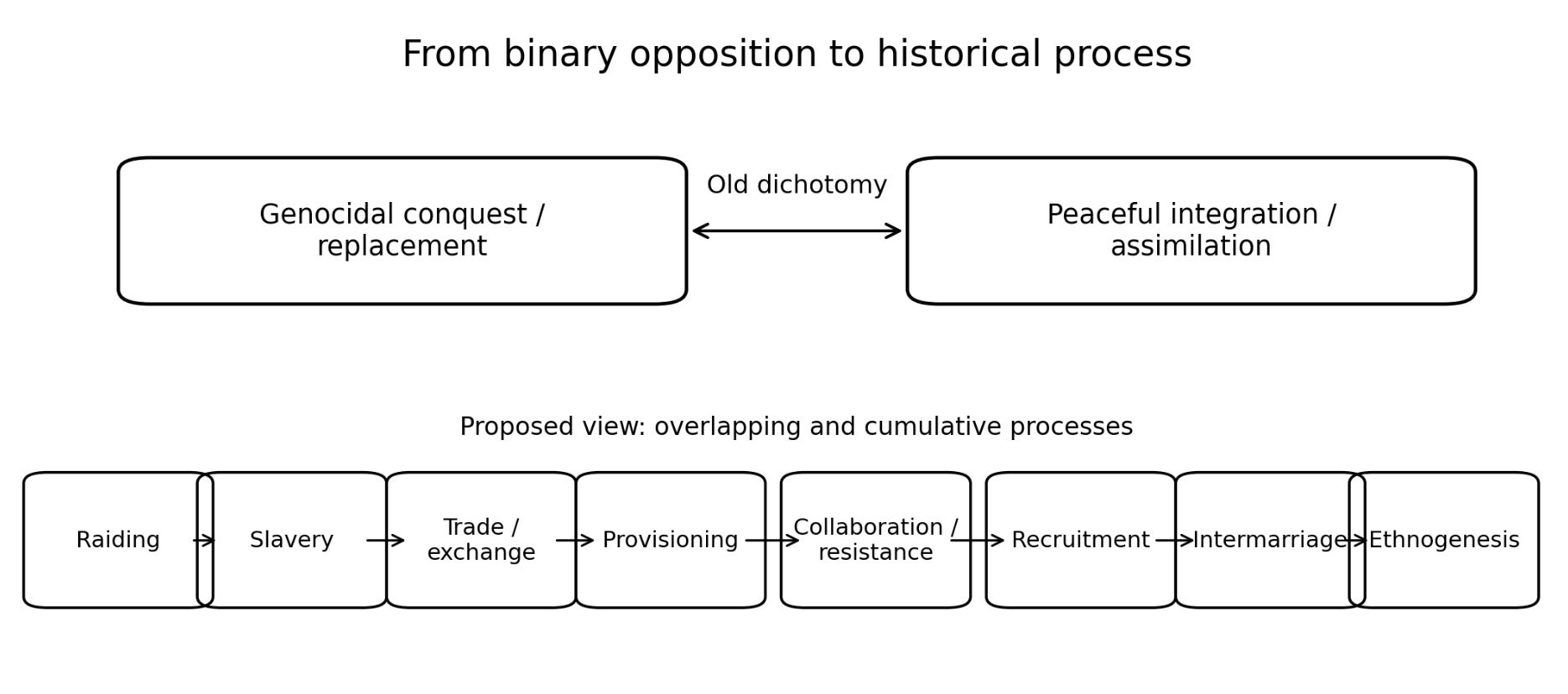
For a long time, discussions, or perhaps arguments, has tended to swing between two extremes. One sees Scandinavian settlement as violent conquest and demographic replacement: newcomers displaced, overwhelmed or perhaps largely eliminated the indigenous population. I used to be a fairly card-carrying member of this team! The other explanation emphasises continuity, intermarriage and integration, with Scandinavians settling among existing inhabitants and a new society gradually emerging. This has sometimes been described as the Peace School.
I am increasingly wondering whether this is the wrong choice. Violence and integration need not have been opposites. More importantly, both interpretations can quietly share the same assumption: that the people doing the Viking activity were Scandinavians, while the islanders were the people to whom Viking activity happened. Two rather different bodies of scholarship have made me question that assumption. The first is the history of pirate communities, which shows how maritime raiding systems depended upon, recruited from and became entangled with shore populations. The second is Island Studies, which warns us against assuming that small island communities are inherently passive or vulnerable. Add to that the awkward medieval fact that non-Scandinavians such as Wends could themselves be called vikings, and another possibility begins to appear. Perhaps Orcadians and Shetlanders became Vikings before their islands became Norse. Hold that thought!
What pirates can tell us about Vikings
I am not suggesting that ninth-century Vikings were early copies of Jack Sparrow, simply Caribbean pirates with different ships. The worlds of Port Royal, Nassau and the Barbary corsairs belonged to very different political, technological and economic circumstances. But the comparison is useful because pirates are comparatively well documented. Their records help us to see the social world behind maritime raiding in much greater detail than we usually can for the early Viking Age.
What emerges is much messier and more interesting than the popular picture of outlaw crews living independently at sea. Successful pirate communities needed land. They needed harbours, food, markets, ship repair, intelligence, merchants prepared to buy stolen goods, and officials willing to turn a blind eye. Hanna’s study of early-modern ‘pirate nests’ shows how closely piracy could become embedded within ordinary shore-based economies (Hanna, 2015). McDonald similarly demonstrates how pirates, merchants, settlers and enslaved people formed overlapping networks across the Atlantic world (McDonald, 2015).
A pirate, in other words, was not necessarily a member of a separate pirate population. A sailor could be a merchant on one voyage, a privateer on another and a pirate on the next. A pirate settlement might contain respectable traders who profited handsomely from piracy without ever boarding a pirate ship. Ports did not merely suffer piracy; some helped sustain it, profited from it, supplied it and recruited into it.
Presumably, medieval Scandinavian pirates needed the same kinds of things that later pirate communities needed: shelter, food, fresh water, local intelligence, repairs, pilots, markets and people who knew the coast. A maritime predatory system cannot exist offshore from society. It has to touch land repeatedly, and every landing creates possibilities for exchange, coercion, collaboration and recruitment.
Because the Vikings were pirates! Medieval writers themselves sometimes used precisely that language. Frankish annalists called Scandinavian raiders piratae: the Annales Bertiniani could describe attackers as piratae Danorum, ‘Danish pirates’, or piratae Nordmannorum, ‘pirates of the Northmen’. The Annales regni Francorum similarly refers to Scandinavian piraticae naves, ‘pirate ships’. Most strikingly, Adam of Bremen later wrote of pyratae, quos illi Wichingos appellant — ‘pirates, whom they call Vikings’. Modern English has turned Viking into something close to an ethnic label. We speak easily of Viking farmers, Viking women, even Viking children, but the Medieval usage was narrower. Of course, that’s not suprising as most of these pirates were of Scandinavian origin. However, in Old Norse víkingr referred to any person engaged in Viking activity, and that activity was víking ‘piracy’, and John Lind reminds us that Medieval Icelandic writers could apply víkingr to raiders who were not Scandinavian at all.
In Hákonar saga góða, Snorri describes Hákon killing víkingar wherever he found them and identifies them as ‘both Danes and Wends’. The Wends were a Slavic people. Elsewhere Wends, Curonians, Estonians and other eastern raiders could also be described as vikings when engaged in piratical predation (Lind, 2012). Viking described what somebody was doing rather than where their ancestors came from. If a Wend could be a víkingr without becoming Scandinavian, why couldn’t a Pict from Orkney or Shetland also participate in the same kind of behaviour?
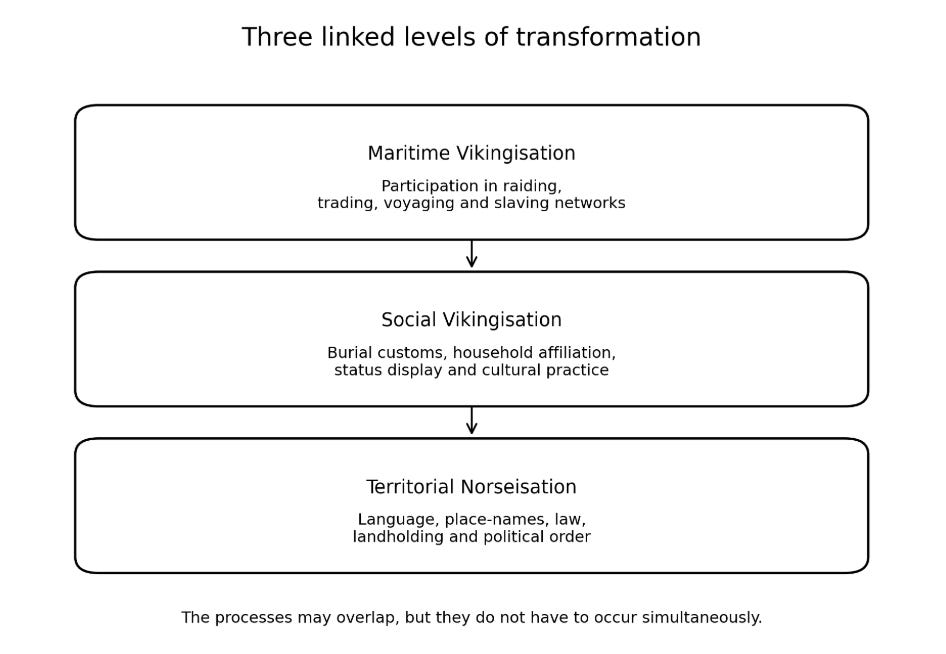
This is where I am going to present two ungainly neologisms, Vikingisation and Norseisation. By Vikingisation I mean participation in raiding, trading, slaving and armed voyaging networks. By Norseisation I mean the much deeper adoption of Norse language, names, political structures, law, landholding and cultural identity. The first could begin before the second. I am becoming more and more convinced we see this process in the Northern Isles.
The pirate comparison also helps us to visualise the latter concept. Pirate frontiers are rarely permanent. States attempt to suppress them, co-opt them or regularise them. This is strikingly similar to the process described in the saga tradition about Harald Finehair King of Norway, and the vikings who were based in Shetland and Orkney, who were using the islands as winter refuges, from which to raid Norway in the summer. Of course, this Harald could not thole, so he eventually responded by sailing his fleet west conquering Shetland and Orkney, and placing them under royal control, and granting them to Jarl Rögnvaldr of Møre, ancestor of the Jarls of Orkney (Orkneyinga saga, ch. 4; Pálsson and Edwards, 1978). The saga makes no comment about the ethnicity of the offending vikings. Harald roots them out because their activities threatened his authority in Norway.
We can’t treat the expedition itself as straightforward ninth-century history. Orkneyinga saga was written centuries later, and the Harald narrative has long been suspected of projecting later Norwegian claims to lordship over the islands back into a previous century. However, that is not a problem. What matters is the kind of past the saga writer was imagining. He envisages a stage before stable Norwegian lordship when the Northern Isles functioned as bases for autonomous maritime raiders, a Viking Orkney and Shetland, before the creation of a Norwegian Orkney and Shetland.
Could a Pict become a Viking?
Pirate literature tells us that predatory pirate communities could be porous. People on shore could provision raiders, trade with them, collude with them in their nefarious activities, marry into their networks, serve as brokers, or just join them. If we apply this perspective to the Viking Age, we could ask how did existing island communities respond to an expanding maritime economy of violence, exchange and mobility? Did they collude?
This is an important question, because invasion narratives usually make local people passive recipients of whatever was thrown at them. We tend to ask what did the newcomers do to them? But people living around maritime frontiers could make choices, even when those choices were constrained by violence and unequal power. Some would resist, some negotiate, some trade, some supply ships, and some would collaborate with raiders against their rivals.
The ninth-century Life of St Findan provides us with an interesting example from the Insular world. Unfortunately for the young Findan, his Irish enemies deliberately arranged for Scandinavian raiders to have him seized. The situation wasn’t simply Irish people on one side and Vikings on the other. Viking violence could be used by locals for their own purposes. Findan was sold between various Scandinavian owners before finding himself being carried north by ship. The vessel reached ‘the Orkney Islands, close to the land of the Picts’. When the crew went ashore to rest, explore and wait for a favourable wind, Findan managed to make his escape.
This is exactly the kind of encounter that pirate history makes easier to imagine. There doesn’t need to have been a Viking farm, nor a permanent Scandinavian colony, nor any conquest as such, for Orkney to have become part of the Viking operational world. The islands could have functioned as stopping places, provisioning points and nodes in a wider network before their landscape looked recognisably Norse.
Now imagine the same process from the island side. Two local families compete for influence. One resists Scandinavian crews. Another supplies food and navigational knowledge. That second family gains silver, prestige or military assistance. A son learns Norse and joins a voyage; he returns with wealth. Success! A daughter marries into a Scandinavian-connected household. Another success! Within two or three generations the second family might look thoroughly Norse to an archaeologist. The first family disappears into obscurity.
No one has simply ‘assimilated’ them. They have participated in a changing maritime system. That’s why I think participation might be a better word than assimilation. Why can we not envision some Picts participating in the very Viking world in which their descendants later lived?
Vulnerable islands or resilient islanders?
There is another reason, I think, why the possibility of active indigenous participation has been easy to overlook: the way islands themselves are imagined. From the mainland perspective islands are often described through the language of smallness, isolation, exposure and vulnerability. If that is your starting point, and lets face it most academics are mainlanders, it is easy to picture Viking ships arriving from outside and overwhelming a fragile island society. Islanders become the people to whom history happens.
However, the discipline of Island Studies has spent a good deal of time questioning this stereotype. Islands and islanders can be vulnerable, of course, but they are often very resilient. Smallness, boundedness and isolation don’t automatically produce weakness, they can produce resilience and innovation, and an openness for outside contact. However, vulnerability and resilience do depend on circumstances.
The same maritime geography that made the Northern Isles accessible to raiders also provided the islanders with the knowledge and skills that the newcomers needed. Islanders knew the anchorages, tides, weather, routes and the neighbouring coasts. They understood where livestock could be obtained, where boats could land safely, which sounds or channels were dangerous, and how to move between islands in poor conditions. Strategic location could make an island a target, but it could also give its inhabitants leverage. The same conditions that produced vulnerability could therefore generate opportunities for negotiation, brokerage, collaboration and entry into the new, exciting maritime networks.
This does not mean that Shetlanders and Orcadians were somehow immune to Viking violence. I have no doubt that raiding, enslavement, killing, displacement and political conquest still remain central to the story. Nor should the idea of ‘islanders are resilient’ simply replace that of the ‘islands are vulnerable’ as another stereotype. I think we are dealing with a methodological point. If we begin by assuming islands host inherently fragile communities, demographic replacement feels completely natural. Instead, if we allow islanders agency and the capacity to adapt, then recruitment, collaboration, selective borrowing and even ethnogenesis become easier to imagine.
I would suggest that the Northern Isles were not simply small pieces of territory onto which a continental model of conquest can be transferred. They were, and are, maritime societies, and their islandness helped shape the encounter.
Can we see this maritime frontier?
If islanders were entering Viking networks before the islands became territorially Norse, and this is not merely a misapplication of Island Studies to Viking Studies, what would we expect to see? Probably not, at first, the things archaeologists are best at seeing. A Scandinavian farmstead is visible. A furnished burial is visible. A house built in a recognisably Scandinavian tradition is visible. But a ship sheltering in a bay for four days leaves nothing tangible. A handful of Scandinavian sailors staying with an indigenous household may leave very little distinctive material behind. A local farmer selling livestock to passing crews remains archaeologically a local farmer. A young Orcadian who joins a Viking crew leaves the islands altogether.
Perhaps some of the apparent archaeological gap in the ninth century exists because we have been looking for the archaeological signature of the tenth.
Simon Buteux’s work at Skaill in Deerness is particularly useful here. He proposed a ‘pioneer stage’ characterised by contact, raiding and trade, perhaps accompanied by winter bases or limited settlement, while Orkney remained predominantly Pictish (Buteux, 1997). This was followed by consolidation, with increasing permanent Scandinavian settlement, and then by a stage in which Norse culture became predominant. Graham-Campbell later regarded the model as having considerable interpretative value (Graham-Campbell, 2003). That’s a relief, because it maps very well on my Vikingisation and Norseisation dichotomy!
The pirate and Island Studies perspectives help fill out what that pioneer stage might actually have involved. I believe it would have required provisioning, exchange, local knowledge, captive movement and relationships with indigenous communities. It may have involved recruitment into Viking crews as well as the beginning of Scandinavian settlement. In that sense, the pioneer stage was not just a chronological waiting room before the ‘real’ Norse settlement began. It may have been a social system in its own right.
Findan fits that model extremely well. His Viking slavers’ ship uses Orkney as maritime infrastructure without telling us anything certain about farms or territorial control. Nearby, after his escape, he eventually encounters a Christian ecclesiastical world connected with Ireland. The precise location of the bishop he meets is uncertain and may have been in neighbouring Pictland rather than Orkney itself, but the broader point remains: Scandinavian maritime activity and an Insular Christian world could exist in close proximity. The sea could change before the land.
Ancient DNA adds another kind of evidence. Margaryan and colleagues analysed Viking-age burials in Orkney, including individuals from Buckquoy and Brough Road, Birsay. Some people buried in recognisably Scandinavian or pagan-style funerary contexts had predominantly British-like rather than Scandinavian ancestry (Margaryan et al., 2020). We cannot simply call them Picts: ancestry is not identity, and they might have come from elsewhere in Britain or Ireland. But the finding does show that Scandinavian cultural affiliation could cross ancestry lines.
That is exactly what the Vikingisation hypothesis, if we can call it that, predicts. A person did not have to possess Scandinavian ancestry to participate in a social world expressed through Scandinavian burial, dress, household affiliation or status practices.
The same point is increasingly visible elsewhere in early medieval Europe. In Anglo-Saxon England, individuals with substantially local British ancestry could be buried in ways conventionally classified as Anglo-Saxon (Gretzinger et al., 2022). Comparable studies of Longobard, Baiuvarian and Avar communities likewise show that culturally or politically named groups could contain people of markedly different ancestry (Amorim et al., 2018; Veeramah et al., 2018; Gnecchi-Ruscone et al., 2025). The details differ, but the lesson is the same: cultural identity and biological ancestry did not map neatly onto one another. Ancestry was not destiny, at least not in all cases.
Slavery provides a more coercive mechanism for the same kind of population mixing. Findan was not simply captured; he was sold and resold. Brink’s work on thraldom underlines how important unfree status was in Viking-age society (Brink, 2021). The later Norman satire Moriuht imagines the same world of capture, transport and sale (McDonough, 1995; Omont, 1894). Captives could be moved through one region into another and eventually become part of new households and communities.
Som new fascinating genetic work shows that movement did not simply run westward from Scandinavia. British- and Irish-related ancestry entered Scandinavian populations during the Viking Age, including individuals in Norway, with a proportionally strong contribution in the north (Rodríguez-Varela et al., 2023; Speidel et al., 2025). Maybe we should not just assume they were slaves. DNA can’t tell us whether these people were captives, spouses, traders or even migrants who had found a new home, but it confirms that the Viking world was circulatory rather than simply colonial.
That is particularly relevant to Orkney and Shetland. Instead of imagining a one-way movement from Norway to the Northern Isles and then onwards to the Hebrides and Ireland, perhaps we should picture a network in which people, goods, information and cultural practices moved in several directions. Instead of just seeing the Northern Isles as mere endpoints of Norwegian colonisation, perhaps they were nodes in a wider seascape.
From Vikingisation to Norseisation
I don’t think we should assume that this means that Scandinavian migration was small or unimportant. Modern genetic work on Orkney and Shetland points to substantial Scandinavian ancestry and to female as well as male migration (Goodacre et al., 2005). Family migration from Scandinavia must remain part of any plausible explanation.
The point is rather that migration entered a world that was already changing. Different islands, and different families within the same island, could have experienced the process in very different ways. One community might suffer violent seizure of land; another might receive substantial Scandinavian settlement; another might initially matter because of a useful harbour; one local elite might resist while another collaborated. However, by the tenth century, however, these different histories could begin to look archaeologically similar.
I think the distinction between Vikingisation and Norseisation is useful. Maritime Vikingisation might begin with the Northern islanders exercising their resilient islander character, overtime participating in raiding, trading, slaving and voyaging networks. Social Vikingisation might involve them adopting Scandinavian burial customs, dress, household affiliation and status practices. Territorial Norseisation came later and went deeper: Norse language, law, landholding, place-naming and political structures became dominant as more Scandinavians moved into the islands. These processes could overlap, but they did not have to happen simultaneously.
We don’t have to see the transition therefore as Picts on one side and Norwegian settlers on the other, followed by a single moment when one population replaced or absorbed the other. It was a changing maritime frontier in which violence, enslavement, migration, collaboration, recruitment, intermarriage and cultural borrowing could all operate at once. A person could be violently enslaved and later incorporated into another community. One local elite might be defeated while another collaborated. Settlers could seize land and subsequently intermarry. Raiders could attack one community and trade with the next. Integration could sometimes be an outcome of violence rather than its alternative.
Seen this way, the transition might move from Pictish island societies through increasing Scandinavian contact, raiding and exchange, seasonal maritime use, slaving and provisioning networks, local participation, Vikingisation, substantial Scandinavian family migration, territorial consolidation, Norseisation and finally ethnogenesis. Different communities would have followed different routes through that process. Complicated! And I think that is the point. Applying Occam’s razor to the interacion of two societies in contact, is too simple, and leads to simple conclusions - peace or war, integration or extermination…
Before the Northern Isles were Norse
So when did the insular Picts disappear? Perhaps there was no single moment, and no one actually noticed until the time Picts or Pettar had become folklore figures. Perhaps the name gradually ceased to describe the social world their descendants inhabited.
Let’s retreat again into the imagination. We have a Norse Viking man marrying, not necessarily just taking, an Orcadian woman. An Irish captive is gven as bride-price, and becomes part of the household. Their neighbours, an indigenous family, enters into the new world-spanning Scandinavian trading and political networks. Their children grow up speaking Norse; their grandchildren have Norse names; they might participate in their family’s Christian communities, or they might not, but they commemorate their dead within an increasingly Norse cultural world. At what point do we stop calling them Picts? Or more to the point, when do they stop calling themselves Picts?
This is what ethnogenesis means. A population can become increasingly culturally homogeneous without ever having possessed homogeneous ancestry. Norse cultural homogeneity may therefore not have existed at the starting point of Viking expansion in the Northern Isles, in sense of an overwhelming early settlement and takeover, but rather it was one of its outcomes.
Let’s return to the two perspectives which I have been discussing. The history of pirate societies shows that maritime raiding depended on shore communities and could recruit people who were not originally part of the raiding population. Island Studies reminds us that islanders are not simply the passive inhabitants of exposed places: their maritime knowledge, networks and adaptive capacities give them agency within new systems.
Of course, the archaeology, texts and genetics do not prove that large numbers of Picts became vikings and then Norse. But I think together they do make the possibility historically serious. Buteux’s pioneer stage gives us a period in which maritime contact could precede territorial Norse settlement. Findan places a slave-carrying Scandinavian ship in ninth-century Orkney. Orcadian aDNA shows people of British-like ancestry participating in Scandinavian cultural traditions. British- and Irish-related ancestry moved back into Scandinavia as well as Scandinavians moving west.
Perhaps, then, the old question - did the Vikings kill the Picts or integrate with them? - has reached the end of its usefulness. We might instead ask when the Northern Isles entered Viking maritime networks; which islanders participated in those networks; who resisted; who collaborated; who was enslaved; who migrated; and how a heterogeneous maritime world eventually became culturally Norse.
The answer was probably different from island to island and family to family. Some people were victims, some migrants, some enslaved, some collaborators, some may have joined Viking crews, some married newcomers, and Scandinavian families arrived in substantial numbers. Out of that mixture emerged a society that none of those groups had brought ready-made with them. However, it was one in whose creation the islanders had exercised agency.
Perhaps the most useful way to approach the early Viking Age, then, is to stop reading it backwards from the Norse world that came afterwards. Before the Northern Islanders became Norse, they may first have become Viking.
References
Amorim, C.E.G., Vai, S., Posth, C. et al. (2018) ‘Understanding 6th-century barbarian social organization and migration through paleogenomics’, Nature Communications, 9, 3547.
Brink, S. (2021) Thraldom: A History of Slavery in the Viking Age. Oxford: Oxford University Press.
Buteux, S. (1997) Settlements at Skaill, Deerness, Orkney: Excavations by Peter Gelling of the Prehistoric, Pictish, Viking and Later Periods, 1963-1981. British Archaeological Reports British Series 260. Oxford: Archaeopress.
Colás, A. (2016) ‘Barbary Coast in the expansion of international society: piracy, privateering, and corsairing as primary institutions’, Review of International Studies, 42(5), pp. 840-857.
Fell, C.E. (1986) ‘Old English wicing: a question of semantics’, Proceedings of the British Academy, 72, pp. 295-316.
Fell, C.E. (1987) ‘Modern English Viking’, Leeds Studies in English, New Series, 18, pp. 111-123.
Gnecchi-Ruscone, G.A. et al. (2025) ‘Ancient DNA reveals reproductive barrier despite shared Avar-period culture’, Nature, 638(8052), pp. 1007–1014..
Goodacre, S. et al. (2005) ‘Genetic evidence for a family-based Scandinavian settlement of Shetland and Orkney during the Viking periods’, Heredity, 95(2), pp. 129-135.
Graham-Campbell, J. (2003) ‘The Vikings in Orkney’, in Waugh, D.J. (ed.) The Faces of Orkney: Stones, Skalds and Saints. Edinburgh: Scottish Society for Northern Studies, pp. 128-137.
Gretzinger, J. et al. (2022) ‘The Anglo-Saxon migration and the formation of the early English gene pool’, Nature, 610, pp. 112-119.
Griffiths, D. (2019) ‘Rethinking the early Viking Age in the West’, Antiquity, 93(368), pp. 468-477.
Hanna, M.G. (2015) Pirate Nests and the Rise of the British Empire, 1570-1740. Chapel Hill, NC: University of North Carolina Press.
Kelman, I. (2020) ‘Islands of vulnerability and resilience: Manufactured stereotypes?’, Area, 52(1), pp. 6-13.
Lind, J. (2012) ‘“Vikinger”, vikingetid og vikingeromantik’, Kuml, 61, pp. 151-170. https://doi.org/10.7146/kuml.v61i61.24501.
Margaryan, A. et al. (2020) ‘Population genomics of the Viking world’, Nature, 585, pp. 390-396.
McDonald, K.P. (2015) Pirates, Merchants, Settlers, and Slaves: Colonial America and the Indo-Atlantic World. Oakland, CA: University of California Press.
McDonough, C.J. (ed. and trans.) (1995) Warner of Rouen: Moriuht: A Norman Latin Poem from the Early Eleventh Century. Toronto: Pontifical Institute of Mediaeval Studies.
Noble, G. et al. (2025) ‘Buckquoy, Orkney: addressing the Pictish-Viking transition in northern Scotland’, Antiquity, 99(408), pp. 1623-1639.
Omont, H. (1894) ‘Satire de Garnier de Rouen contre le poète Moriuht (Xe-XIe siècle)’, Annuaire-Bulletin de la Société de l’Histoire de France, 31, pp. 193-210.
Pálsson, H. and Edwards, P. (trans.) (1978) Orkneyinga Saga: The History of the Earls of Orkney. London: Hogarth Press.
Rodríguez-Varela, R. et al. (2023) ‘The genetic history of Scandinavia from the Roman Iron Age to the present’, Cell, 186(1), pp. 32-46.e19.
Speidel, L. et al. (2025) ‘High-resolution genomic history of early medieval Europe’, Nature, 637, pp. 118-126.
Veeramah, K.R. et al. (2018) ‘Population genomic analysis of elongated skulls reveals extensive female-biased immigration in Early Medieval Bavaria’, Proceedings of the National Academy of Sciences, 115(13), pp. 3494-3499.
Vita Findani (1887) in Holder-Egger, O. (ed.) Monumenta Germaniae Historica, Scriptores, 15.1. Hanover: Hahn, pp. 502-506.
Woolf, A. (2025) ‘The Viking paradigm in early medieval history’, Early Medieval England and its Neighbours, 51, e2.
No evidence of a Pictish population in Shetland beyond the end of the 6th Century following the climate disaster of the Late Antique Little Ice Age (LALIA). Shetland was likely uninhabited until the arrival of the pioneering monks probably in the late 7th Century. Before the Vikings and/or Norse Shetland's population would only have been scattered monastic enclaves indicated by Shetland's Papar placenames.
Since my research paper on the effects of LALIA on Shetland (https://www.ssns.org.uk/journal/northern-studies-54-2023/) was published there is now tephra evidence that the 536AD volcanic eruption that triggered the climate disaster was the Askja volcano in Iceland. The nearest population to Askja was in Shetland as was likely to be more adversely affected than the well researched settlement abandonment, famine and plague in Scandinavia or Europe.
No evidence of a Pictish population in Shetland beyond the end of the 6th Century following the climate disaster of the Late Antique Little Ice Age (LALIA). Shetland was likely uninhabited until the arrival of the pioneering monks probably in the late 7th Century. Before the Vikings and/or Norse Shetland's population would only have been scattered monastic enclaves indicated by Shetland's Papar placenames.
Since my research paper on the effects of LALIA on Shetland (Did the Fimbulwinter Eradicate Shetland’s Picts?) was published there is now tephra evidence that the 536AD volcanic eruption that triggered the climate disaster was the Askja volcano in Iceland. The nearest population to Askja was in Shetland as was likely to be more adversely affected than the well researched settlement abandonment, famine and plague in Scandinavia or Europe.