
Thank you so much for having me — and what a wonderful setting for a conference. The Faroe Islands feel like exactly the right place to be talking about islands, identity, and the edges of the Norse world, I wish I was there! However, Shetland is not too bad an alternative!

My name is Andrew Jennings, and my paper today is called Hebrideans... Weirdos! — which I hope gives you a sense of both the subject matter and the tone I’m aiming for. It’s a title that comes directly from the sagas themselves, in a way, because the Hebrideans in Old Norse literature really are treated as a rather suspicious and peculiar bunch.
What I want to do over the next forty minutes is explore why that is — what it tells us about how medieval Icelanders thought about cultural mixing, proximity, and the boundaries of their own world. We’ll be looking at sorcerers, revenants, people with catastrophically destructive eyes, and some seals. So I hope you’ll find it an enjoyable journey.
Right — let’s begin.
I. Introduction: The Liminality of the Suðreyjar
In this paper I will examine the representation of Hebridean figures in the Icelandic saga corpus, focusing on how these characters embody deep-seated anxieties concerning cultural hybridity and the boundaries of the Norse world.
Drawing on the “gradations of familiarity” framework established by Catriona Ellis, in her 2020 paper ‘Degrees of separation: Icelandic perceptions of other Scandinavian settlements’, I argue that by the thirteenth century the Hebridean (suðreyskr maðr) had evolved into a distinct and dangerous literary type, characterised by associations with aggressive magic, unregulated violence, and uncanny transformations — specifically the recurring motif of the seal-human hybrid.
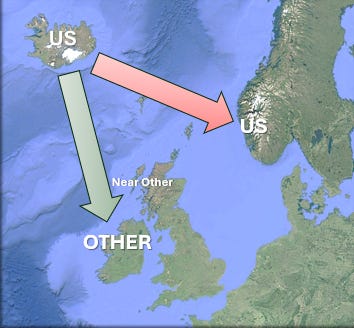
The medieval Icelandic worldview was not a simple binary of “Self” and “Other,” but rather a sophisticated spectrum of cultural proximity. As Catriona Ellis (2020) has demonstrated, Icelandic perceptions of the Norse diaspora were structured through what she terms “gradations of familiarity.” In this mental geography, Norway and the Northern Isles (Orkney and Shetland) occupied a “lateral axis” of relative continuity — regions that were culturally, linguistically, and legally intelligible to the Icelandic mind. These were the lands of ancestors, the sources of law, and the targets of legitimate trade. The Shetlanders (Hjaltlendingar), for instance, are never portrayed as “Other,” despite one bearing the nickname bakrauf, “arsehole.”
The Hebrides — the Suðreyjar or “Southern Isles” — occupied the far more ambiguous position of a “vertical axis,” connecting Iceland with the Hebrides and Ireland. Situated at the confluence of the Scandinavian and Gaelic worlds, the Hebrides were neither wholly external nor comfortably internal to the Norse cultural sphere. They existed within a liminal zone of hybridity, where Norse identity was perpetually entangled with, and transformed by, Gaelic influences.
I would like to argue that the saga corpus reflects a growing anxiety regarding this cultural hybridity. As direct contact declined in the later medieval period, the Hebridean emerged as a powerful literary trope: the “Near Other.” Unlike the “Distant Other” of the Sami (Finnar) or the Native Americans (Skrælingar), whose difference was geographically and culturally remote (Athanasiou 2024), the Hebridean was a figure of unsettling proximity. They bore Norse names, shared settlement histories, and moved within the same maritime networks, yet they carried with them what can be termed the “contagion” of the foreign — specifically in the form of Gaelic magic and antisocial behaviour.
II. The Hebrides and the Norse Diaspora
In the early phases of the Viking Age, the Hebrides were integral to the Norse Atlantic network. Archaeological, historical, and literary evidence all point to sustained contact between Norway, the Northern Isles, the Hebrides, and Ireland. The settlement of Iceland itself was closely connected to these movements, with Landnámabók preserving numerous references to settlers with Hebridean associations.
Among the most prominent figures is Auðr the Deep-Minded, daughter of Ketill Flatnose, who is associated with the Hebrides and plays a central role in Icelandic settlement traditions. Her story is significant because it highlights the Hebrides as a site of cultural transmission. According to Landnámabók, Auðr had adopted Christianity in the Hebrides prior to her arrival in Iceland, raising crosses and practising private devotion — a detail that frames the Hebrides not as peripheral but as a conduit for religious and cultural exchange within the North Atlantic world. In her train were several Hebridean figures: her brother Helgi bjólan, her nephew and foster-son Örlyggr Hrappson, who founded and dedicated a church to Columba, her great-nephew Ketill inn fíflski “the Foolish” (so named for his Christian belief), and her grandson Óláfr feilan. All must have been conspicuous as Christians in a pagan milieu; Helgi and Óláfr apparently bore Gaelic saints’ names as nicknames.
Further evidence of Hebridean participation in Norse expansion is found in the figure of Grímr Kamban, whose Gaelic nickname means “shinty stick” or “little bent one,” and in the anonymous poet of Hafgerðingadrápa, described explicitly as a suðreyskr maðr. Composed during a voyage to Greenland, the poem invokes divine protection and is notable not only for its Christian content but for its geographical context, situating a Hebridean within the wider movement of Norse Atlantic expansion.
The anonymous poet was not the only Hebridean to visit Greenland. According to Eiríks saga rauða, when Leifr is driven off course to the Hebrides, he has an affair with a noblewoman of unusual gifts, called Þórgunna, which results in the birth of a son, Þorgils. Leifr refuses to elope with her, and she warns that he is unlikely to enjoy having his son — but that the boy will eventually follow his father to Greenland, which in due course he does. The saga’s comment on Þorgils is pointed: “there seemed to be something uncanny [or weird] about him all his life.” This remark anticipates the wider literary pattern in which the Hebridean ceases to be a noble ancestor, like Auðr the Deep-Minded, and becomes instead something weird, aggressive, and antisocial.
To understand why this literary stereotype crystallises in the thirteenth century, it is necessary to consider what was actually happening to the political relationship between the Norse world and the Hebrides during the period in which the sagas were being composed.
In the ninth and tenth centuries, the Hebrides had been thoroughly integrated into the Norse Atlantic network. Norse settlement was substantial, Norse lordship was exercised, and the movement of people, goods, and ideas between Iceland, the Northern Isles, the Hebrides, and Ireland was continuous and largely unremarkable. However, there was also an extensive period of cultural mixing and Gaelicisation of the Norse Hebridean community.
From the eleventh century onwards, however, the political situation in the Hebrides became increasingly unstable and contested. The islands passed in and out of effective Norse control, subject to the competing pressures of the Kingdom of Norway, the Scottish crown, and local Hebridean lordships. The Battle of Largs in 1263, in which a Norwegian expedition under King Hákon Hákonarson failed to reassert Norse authority in the western isles, proved the decisive turning point. The subsequent Treaty of Perth in 1266 formally transferred sovereignty over the Hebrides — and the Isle of Man — from Norway to Scotland. After 1266, the Hebrides were, in political terms, no longer part of the Norse world at all.
The significance of this chronology for the saga corpus is considerable. The major sagas dealing with Hebridean figures — Laxdæla saga, Brennu-Njáls saga, Eyrbyggja saga, and Vatnsdæla saga — were all composed in the thirteenth century, precisely during the period in which Norwegian sovereignty over the Hebrides was being challenged and ultimately lost. The Hebrides were slipping away from the Norse imaginative world even as the sagas were being written. This context helps to explain both the intensity of the literary stereotype and its particular character. The Hebridean in the sagas is not simply a foreign figure but a formerly familiar one — a part of the Norse world that was in the process of becoming irrecoverably other. The literary construction of the dangerous, hybrid Hebridean may therefore be understood in part as a response to a real historical process of estrangement: the sagas were, among other things, working through the cultural and imaginative consequences of a world that was contracting.
It is also worth noting that the sagas were composed in Iceland at a moment of acute internal political instability. The Sturlung Age — roughly 1220 to 1264 — was a period of violent civil conflict between powerful Icelandic chieftain families, culminating in Iceland’s submission to Norwegian sovereignty in 1262–64. Anxieties about identity, loyalty, social order, and the fragility of law were not merely abstract concerns for thirteenth-century Icelandic authors: they were lived political realities. The figure of the Hebridean — characterised, as we will see, by refusal to pay compensation, violation of social bonds, and resistance to the frameworks of order — may have carried particular resonance for audiences who were experiencing precisely those failures of social order at first hand.
III. Magic and the Hebridean Stereotype
The most consistent and defining feature of Hebridean representation in the Icelandic sagas is an association with the supernatural, and with magic — particularly seiðr. In Old Norse sources, this form of sorcery is framed as morally ambiguous, socially disruptive, and unmanly (ergi) when practised by men.
The most developed example of this supernatural connection is found in Laxdæla saga, in the account of the Hebridean family of Kotkell. The saga introduces them in explicitly marked terms: “These people had come from the Hebrides. They were all extremely skilled in witchcraft (mjök fjölkunnig) and were great sorcerers... their presence there was not well liked.” Their identity as Hebrideans is inseparable from their role as practitioners of dangerous, socially destabilising magic. Accused of both sorcery and theft, their presence is described as making life “unbearable” — a combination of criminality and supernatural power that reinforces their position as outsiders operating beyond accepted norms.
The most dramatic demonstration of their power is the storm episode. In response to legal action taken against them, Kotkell and his family construct a seiðhjallr — a ritual platform — and perform incantations against their enemy Þórðr Ingunnarson. As the saga says:
“Kotkel erected a large seiðhjallr, and they all climbed onto it; there they chanted potent incantations — these were magic spells. And presently a tempest arose.”
This storm is not a natural phenomenon. It is explicitly directed violence: Þórðr “realized that the storm was directed against him.” The result is catastrophic — a wave strikes the ship where no wave had ever struck before, and Þórðr and all his companions are drowned.
In a later episode, the family perform seiðr from the roof of a house, as the saga says:
“They climbed on to the roof of Hrút’s house and made great incantations there... sweet was the singing they heard.”
The apparent beauty of the sound is deceptive. The enchantment draws its victim, Hrút’s twelve-year-old son Kári to his death:
“He began to feel very restive, and eventually he got up and went to look outside; he walked into the seiðr and fell down dead at once.”
He is not attacked physically; he is drawn to his death through enchantment.
As well as practising seiðr, Kotkell’s sons possessed the evil eye. One of them, Hallbjörn, bore the epithet slikisteinsauga — “sleekstone eye,” referring to a tool used in flattening cloth, a traditionally female sphere of labour that reinforces the theme of unmanliness associated with male sorcerers. On being executed, he turns his gaze back towards the land and delivers a curse:
“It was not a lucky day for our family when we came to this Kambsness... And now I lay this curse, that Þorleikr will enjoy little happiness there from this day on, and that all his successors at Kambsness will inherit nothing but trouble there.”
This curse is noted by the saga to have been very effective.
His brother Stígandi possesses a gaze so malignant it is practically a biological weapon. When he was captured and a bag placed over his head, a tear in the bag allowed him to glimpse the hillside opposite and “suddenly it was as if a whirlwind came and turned the whole sward upside down, so that no grass has ever grown there since.” This trope resonates strongly with the Gaelic mythological tradition of Balor of the Fomorians, the malevolent cyclops whose gaze brought fire and destruction — a parallel to which I return in the postscript. Hallbjörn’s body was washed ashore but, once buried, he did not rest quietly in his grave. He became the first of this paper’s three Hebridean draugar — revenant, walking dead.
IV. Violence and the Breakdown of Social Order
Alongside magic, Hebrideans in the saga corpus are consistently associated with violence that is not merely frequent but structurally disruptive — violence that undermines the social and legal frameworks upon which Icelandic society depends.
The most developed example is the figure of Þjóstólfr in Brennu-Njáls saga. He is “a Hebridean by descent” and the foster-father of Hallgerðr “Long-legs.” He is introduced in terms that immediately emphasise both his physical power and his moral deviation: “He was a strong man and a great fighter; he had killed many men and paid compensation for none.” His very name is derived from þjóstr, meaning fury. The refusal to participate in the system of compensation (bætur) is critical. Within the saga world, violence is not in itself aberrant, but it is expected to be contained within a framework of law, negotiation, and restitution. Þjóstólfr’s conduct represents a structural rejection of this framework.
His violence is also marked by deliberateness and intensity. Acting as an enforcer on behalf of Hallgerðr, he murders her first two husbands not as part of a feud governed by escalating obligation, but as targeted acts of elimination. In one instance, he pursues Þórvaldr across a considerable distance by sea, rowing alone until he overtakes him:
“Þjóstólfr rowed after him until he came up with him, and then he struck him with his axe and split him down to the shoulders.”
When he kills again, the violence is once more direct and unrestrained:
“He dealt him his death-blow at once, and it is said that he laughed when he struck.”
The detail of laughter is particularly striking. It signals not merely violence but a detachment from the moral gravity of the act, emphasising his position outside the ethical norms of the Icelandic Commonwealth. Þjóstólfr’s role is therefore not that of a conventional feud participant but of a destabilising force — an individual whose actions accelerate conflict while bypassing the mechanisms designed to contain it.
This pattern finds a parallel in the figure of Svartr in Vatnsdæla saga, described as “big and strong, unpopular and contrary.” Svartr’s defining act — killing a man after residing with him over winter — constitutes a profound violation of hospitality, one of the foundational social bonds in the saga world. Here, as with Þjóstólfr, violence is not simply physical but structural, directed against the norms that sustain social order.
Taken together, these figures establish a clear pattern. Hebridean violence in the sagas is deliberate rather than reactive, unregulated rather than compensatory, and socially corrosive rather than contained. In this sense, these figures function as agents through which the sagas explore the limits of order — exposing the fragility of a system dependent upon restraint, negotiation, and mutual recognition.
V. Death, Haunting, and the Uncanny
Let’s return to the draugar, the revenant walking dead. The association of Hebrideans with violence and the supernatural reaches its fullest expression in the motif of the revenant. It is here that the concept of hybridity moves from the cultural to the ontological. The Hebridean figure becomes a being inhabiting the boundary between life and death, and between human and animal.
Laxdæla saga provides the chilling example of Víga-Hrappr (Killer-Hrapp), explicitly marked as culturally mixed: “Scottish on his father’s side... whereas all his mother’s family came from the Hebrides,” having himself been “born and brought up there.” This is not incidental detail. It situates Hrapp precisely within the hybrid Norse-Gaelic milieu that generates unease in Icelandic narrative tradition.
In life, Hrapp already embodies the traits associated with the Hebridean stereotype. He is “a big, strong man who would never yield to anyone... and refused to pay compensation for his misdeeds.”
His behaviour intensifies over time: “He became more and more brutal; he molested his neighbours so relentlessly that they could scarcely hold their own against him.”
Yet it is in death that Hrapp becomes truly significant. On his deathbed, he gives extraordinary instructions:
“When I am dead I want my grave to be dug under the living-room door, and I am to be placed upright in it under the threshold, so that I can keep an even better watch over my house.”
Burial in a liminal architectural space — neither fully inside nor outside — perfectly reflects Hrapp’s symbolic position. He is a threshold figure, and his refusal to remain “dead” or “buried” is a physical manifestation of his refusal to abide by social or natural boundaries.
The consequences are immediate:
“Difficult as he had been to deal with during his life, he was now very much worse after death, for his corpse would not rest in its grave; people say he murdered most of his servants in his hauntings after death, and caused grievous harm to most of his neighbours.”
His body is eventually exhumed and relocated, yet the consequences persist. His son, who attempts to inherit the property, “went mad, and died soon afterwards.” Further deaths follow, including the drowning of Þórsteinn the Black and his party as they approach Hrapp’s abandoned settlement. Significantly, this episode introduces another uncanny element:
“Throughout the day they saw an enormous seal swimming in the current; it circled the boat all day. It had huge flippers, and everyone thought its eyes were those of a human. Þórsteinn told his men to harpoon the seal, but all their attempts failed.”
The implication is that Hrapp’s agency persists in this altered form.
Alongside Víga-Hrappr, the figure of Þórgunna, in Eyrbyggja saga provides a complementary example of the Hebridean association with the uncanny and the restless dead. She arrives in the year 1000 on a ship from Dublin whose crew came from Ireland and the Hebrides, and is invited to stay at the farm at Fróðá. She is physically imposing — “a massive woman, tall, broad-built, and getting very stout... hard to get on with and wasted little time on conversation” — and, like Hrapp, socially marginal despite being physically present. She goes to Mass every morning but remains distant from her hosts. She is probably the same Þórgunna mentioned previously who wanted to elope with Leifr.
Before her death at Fróðá, a striking omen occurs during haymaking: a sudden storm brings a shower of blood that falls on the farm. Everything dries afterwards — except Þórgunna’s hay and rake. When Þóroddr, the farm’s owner, asks what the omen means, she replies: “Most likely it forebodes the death of someone here.” Indeed, it foretells her own.
On her deathbed, she gives detailed instructions regarding her burial and possessions, including a critical warning: “My bed and all its furnishings I want burnt to ashes... I wouldn’t like to be responsible for all the trouble people will bring on themselves if they don’t respect my wishes.” Her instructions are ignored, and terrible consequences rapidly unfold.
While her corpse is being transported by Þóroddr and his men to Skálholt for burial, the party stops at a farm whose stingy owner refuses them food. That night, her revenant corpse is seen in the larder: stark naked, preparing a meal. She carries the food into the living room, lays the table, and serves it. When the farmer then makes the party welcome, she walks out and does not reappear. She is eventually buried at Skálholt, but because her warnings about her bed-furnishings were not heeded, a series of supernatural events unfold at Fróðá — the most famous hauntings in saga literature. Among these is the appearance of a seal’s head rising through the floor of the living room, followed by its flippers, turning its eyes towards the canopy from Þórgunna’s bed. According to the saga:
“One of the farm-hands came up and started hitting the seal, but it kept rising further up with every blow, until its flippers emerged. At that the man fainted, and everyone was paralyzed with horror, except for young Kjartan, who rushed up with a sledge-hammer and struck the seal on the head. It was a powerful blow, but the seal only shook its head and gazed around. Kjartan went on hammering the head and driving it down like a nail into the floor till the seal disappeared, then he flattened out the floor above its head.”
The recurrence of the seal motif across two separate sagas demands closer attention than it has typically received. In both cases, the seal appears at a moment of transition: it follows the death of a Hebridean figure whose agency has persisted beyond the grave, and it manifests in a form that is simultaneously animal and uncannily human. In Laxdæla saga, the seal with human eyes circles the boat that will carry Þórsteinn the Black to his death near Hrapp’s farm. In Eyrbyggja saga, the seal’s head rises through the floor of the living room at Fróðá, turning its gaze towards the bed-canopy that Þórgunna had warned must be destroyed. In both instances, the seal does not act directly — it watches. Its function is to signal, to witness, and perhaps to preside. It is the presence of something that has crossed a boundary and cannot, or will not, cross back.
The choice of the seal is not arbitrary. The seal is, in biological and cultural terms, precisely a liminal creature — one that inhabits the boundary between land and sea, between the familiar and the unknown. In the Norse and Gaelic worlds alike, the sea was the realm of the unpredictable, the dangerous, and the supernatural. The seal, which moves between that realm and the human world of the shore, was a natural folkloristic metaphor for characters that similarly moved between categories: the living and the dead, the Norse and the Gael.
When the saga authors placed seals at the threshold moments of their Hebridean narratives, they were therefore not simply reaching for a convenient image of the uncanny. They were drawing on a living imaginative tradition in which the seal already carried precisely the symbolic freight the narrative required: liminality, transformation, the persistence of identity across categorical boundaries, and the specific hybridity of the Norse-Gaelic world. The Hebridean draugr who manifests as a seal is not becoming something alien. He or she is becoming something that was always already implicit in the cultural logic of Hebridean identity — a creature of two worlds, belonging fully to neither, watching from the threshold with eyes that everyone knew were human.
In Þórgunna and Víga-Hrappr we have two socially disruptive Hebrideans who become draugar after death and who appear, in some form, to become seals. Alongside the stories of Kotkell and his family, we also have three drowning events associated with Hebrideans — because after Þórgunna’s burial and the seal incident, Þóroddr and his men are all drowned and take to haunting Fróðá in turn.
VI. The Heroic Exceptions: Kári Sölmundarson, Álfgeir, and the Limits of the Hebridean Stereotype
Amid the recurring portrayal of Hebrideans as hybrid agents of magic, violence, and social disruption, the figure of Kári Sölmundarson in Brennu-Njáls saga stands as a striking and deliberate exception. Introduced explicitly as ór Suðreyjum — from the Hebrides — Kári might be expected to conform to the established pattern. Instead, he emerges as one of the most loyal, capable, and morally grounded figures in the saga corpus.
This apparent contradiction is not accidental. Kári’s character reveals the conditions under which Hebridean identity could be rendered acceptable — or even exemplary — within the Icelandic narrative imagination. His legitimacy is grounded in genealogy and affiliation. Although associated with the Hebrides, he is not presented as culturally unstable in the way Kotkell or Hrapp are. His lineage connects him to Þorbjörn “Jarl’s Champion” and through that line to the Orcadian court — situating him within the prestigious lateral axis linking Iceland, Orkney, and Norway, rather than the more ambiguous vertical axis of the Hebrides and Ireland. His service to Sigurðr the Stout, Earl of Orkney, reinforces this positioning, and in narrative terms he embodies the virtues most valued in the saga world: loyalty, endurance, and controlled violence.
A similar, if less fully developed, pattern appears in the figure of Álfgeir in Eyrbyggja saga. Explicitly identified as a Hebridean, he arrives as captain of a ship jointly owned by Norwegians and men of the Hebrides. He is not a sorcerer or outsider but a leader among his men, integrated into the social world of his Icelandic hosts. When conflict arises at Mávahlíð, he functions not as a destabilising force but as an ally — good in a fight and sound in counsel. He is contrasted directly with his Scottish companion Nagli, described as well-built and a swift runner, but given to flight. A skaldic verse celebrating Álfgeir captures the contrast:
The grovelling Nagli, little gave he to glut hungry ravens as he ran snivelling up the ridge: as for helmed Alfgeir, eager for the war-play was the warrior, wielding his steel-bright weapons.
Compared to a Scot, Álfgeir is reliably Norse. Taken together, Kári and Álfgeir suggest that Hebridean identity in the sagas is not uniformly negative but conditionally acceptable. Both figures demonstrate that Hebrideans could be integrated into Icelandic society and their martial abilities valued rather than feared. They represent the possibility of controlled hybridity — a form of identity that can be accommodated, provided it is aligned with Norse authority, social order, and narrative purpose.
Conclusion
The Hebridean in the Icelandic sagas is a figure of considerable complexity and narrative significance. Positioned at the intersection of familiarity and difference, the Hebridean serves as a vehicle through which Icelandic authors explored the boundaries of identity, order, and cultural belonging.
Through recurring associations with Christianity in the earlier pagan period, and with magic, violence, and the supernatural in the later Christian period, the Hebridean becomes a narrative embodiment of instability — set in opposition to societal norms and expressive of anxieties surrounding hybridity and the limits of the Norse world. Figures such as Kotkell, Hrapp, and Þórgunna demonstrate how this instability could manifest across multiple domains: social, environmental, domestic, and ontological. Yet the inclusion of figures such as Kári Sölmundarson and Álfgeir complicates this picture. They could function as Norsemen — and impressive ones at that. The Hebridean is therefore not simply an “other” but a conditional other — a figure whose meaning depends upon context, alignment, and control.
The comparison with the Sami suggests a final way of understanding the particular force of the Hebridean stereotype. Both groups are situated at the margins of the Norse world and associated with specialised knowledge, especially in relation to magic and the manipulation of natural forces. Yet their narrative roles diverge in a significant respect. The Sami remain, for the most part, external to Icelandic society — figures encountered at a distance, whose difference can be observed, categorised, and at times incorporated without destabilising the social order. The Hebrideans, by contrast, belong to the same migratory world as the Icelanders themselves. They appear in settlement traditions, enter into kinship networks, and continue to move within the same maritime sphere. Their difference is therefore not distant but proximate.
It is this proximity that gives the Hebridean figure its particular narrative charge. Because Hebrideans could be neighbours, ancestors, and participants in Icelandic society, their hybridity — understood as a blending of Norse and Gaelic elements — becomes a source of tension rather than simple distinction. If the Sami represent the distant edge of the Norse world, the Hebrideans mark its unstable interior boundary, where identity is no longer secure and must be actively negotiated. The Hebridean is not merely an “other” but a near other — a figure whose closeness makes difference more difficult to contain.
Postscript
Finally, what are we to make of the fact that the stories associated with Hebrideans in saga material have parallels in Gaelic and Old Irish tradition?
There is the destructive gaze of Stígandi, which closely recalls Balor of the Evil Eye in the Cath Maige Tuired, whose sight brings devastation and death. There is the blood-rain episode associated with Þórgunna, which finds a clear analogue in Irish annalistic tradition, where phenomena such as “blood falling over Ireland” are recorded in the Annals of Ulster as ominous portents of death and upheaval. The case of Víga-Hrappr introduces a further parallel: his burial upright beneath the threshold, so that he may continue to “watch over” his household, resonates with the Irish tradition concerning Lóegaire mac Néill, said to have been interred standing, armed, and facing his enemies at Tara. Where Lóegaire’s burial is framed in heroic and royal terms, Hrapp’s is antisocial and destructive — yet the shared emphasis on upright interment is clearly a shared motif.
Then of course, there is the seal imagery. Seals occupy a more prominent position in Hebridean and West Highland Gaelic folklore than in Icelandic tradition, appearing in stories of human-seal hybridity and interbreeding. The Gaelic conception of seals as Clann Righ Lochlainn fo gheasaibh — the children of the King of Norway under enchantment — and the tradition that the MacCodrums of North Uist descended from a seal woman, both point to a rich imaginative framework centred on these liminal, hybrid beings. The Gaelic word for seal, ròn, is even embedded in Gaelic personal names: Mugrón, Abbot of Iona (d. 980 AD), and St Rónain, Abbot of Kingarth (d. 737 AD). For an audience in the Faroe Islands, the resonance of this tradition will need no underlining: the seal lore of the Faroese, with its own rich traditions of human-seal encounter and transformation, belongs to the same broad cultural complex.
Taken together, it seems to me that these parallels suggest that the saga authors were drawing on a Gaelic imaginative framework to highlight the hybridity of the Hebrideans — and that this framework was available to them because it had been transmitted, through the Hebridean community itself, into the cultural milieu of the Norse Atlantic world.
John Shaw (2002) in his study of Gaelic Norse folklore contacts came to a similar conclusion. He suggested “Gaelic” elements in Icelandic sagas likely arrived via Hebridean migrants. One of his examples is particularly intriguing, he noted the striking parallel between the story of Glámr in Grettis saga and Scottish Gaelic oral tradition. Glámr is not described as a Hebridean, but he is a draugr and terrorizes the hero Grettir by straddling his roof and kicking the house with his heels. A nearly identical motif exists in the Lochaber region of Scotland, where a man named Dòmhnall Bàn is haunted by a bòcan (ghost) that similarly rides the rooftop and kicks the walls. Shaw argues the words used are almost identical, and suggests that this motif is a surviving vestige of a formerly widespread body of shared tale elements.
I hope this has given you something to think about — and perhaps made you look at the seals out there in the harbour with slightly more suspicion than before.
Thank you very much for listening. I’m very happy to take any questions.
And I will leave the last word to Jarl Rögnvaldr of Orkney, who warned that “Not many Hebrideans are to be trusted...”
Bibliography
Athanasiou, T. (2024) ‘Finnar, Skrælingar, and the Orkney Picts: A Comparative Study of the Imagined “Other” in Early Medieval Norse Culture’, in O. Plumb and A. Sanmark (eds) Alternative Facts and Plausible Fictions in the Northern European Past. Turnhout: Brepols, pp. 17–32.
Byock, J. L. (2001) Viking Age Iceland. London: Penguin Books.
Ellis, C. (2020) ‘Degrees of separation: Icelandic perceptions of other Scandinavian settlements’, Viking and Medieval Scandinavia, 16, pp. 1–26.
Hermann Pálsson (1996) Keltar á Íslandi. Reykjavík: Háskólaútgáfan.
Howarth, J. (2017) Fierce, Barbarous, Unbiddable: Perceptions of Norse-Gael Identity in Orkney-Caithness c. 1000-1400. MA Thesis, University of Oslo.
Kanerva, K. (2011) ‘The role of the dead in medieval Iceland’, Collegium Medievale, 24, pp. 23–49.
Kristjánsson, J. (1988) Eddas and Sagas: Iceland’s Medieval Literature. Translated by P. Foote. Reykjavík: Hið íslenska bókmenntafélag.
Raudvere, C. (2002) ‘Trolldómr in Early Medieval Scanidinavia, in Witchcraft and Magic in Europe. London: Athlone.
Sayers, W. (1992) ‘ Sexual Identity, Cultural Integrity, Verbal and Other Magic in Episodes from Laxdœla saga and Kórmaks saga, Arkiv för nordisk filologi, 107, pp. 131–155.
Shaw, J. (2008) ‘Gaelic/ Norse Folklore Contacts and Oral Traditions from the West of Scotland’, in T. Gunnell (ed.) Legends and Landscape. Reykjavík: University of Iceland Press, pp. 235-272.
Tulinius, T. H. (2002) The Matter of the North: The Rise of Literary Fiction in Thirteenth-Century Iceland. Odense: Odense University Press.