
I am standing in the woods near Logie Coldstone looking out over Loch Kinnord. It is a peaceful spot, but one with a rather interesting history. According to local tradition, Malcolm Canmore, or Malcolm III of Scotland, once had a palace of some kind on the larger of the loch’s islands. Whether he actually lived here is another matter, but the stories associated with the place are worth exploring.
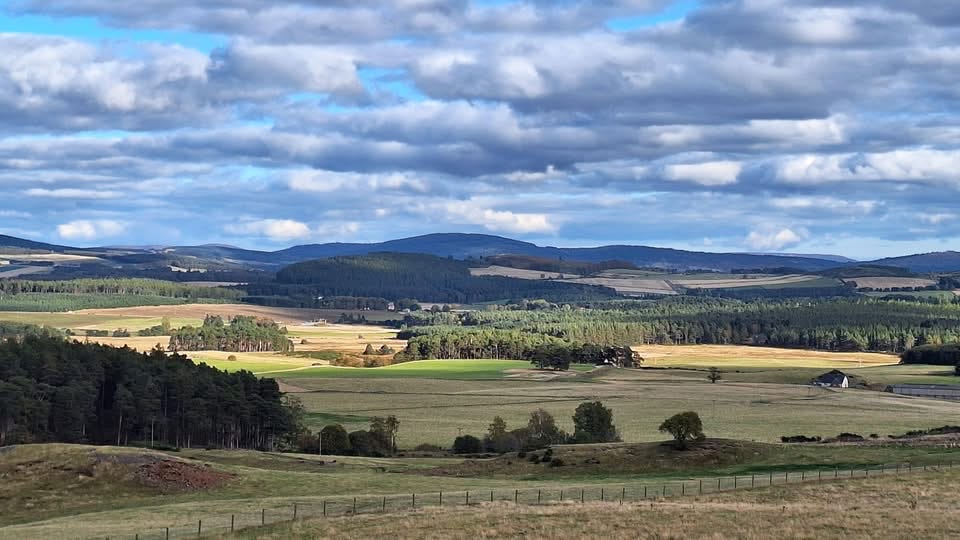
The Howe of Cromar wherein lie Logie Coldstone and Loch Kinnord
In his 1910 account of the antiquities of Loch Kinnord, J. G. Michie remarked that in this part of Aberdeenshire, “the Celtic habit of passing on from generation to generation ‘the tales of other years’ survived in full force almost till the present day.”
One of these tales concerns an argument between Malcolm and his queen following a hunting expedition. Malcolm returns to his island residence, apparently rather pleased with himself, only to be mocked by his wife. The king takes offence. According to the version recorded by Michie, he tells her “that he would do as much by her kith of Denmark as he had done to the game he had that day bagged, in token whereof he dangled a ptarmigan before her face.”
The queen is unimpressed and challenges Malcolm to repeat the threat in front of her brother. From this domestic disagreement the story develops into something rather more serious, involving a feud, an ambush during dinner and eventually a battle on the Moor of Dinnet, where the Scots defeat the “Danes”.
Michie was not particularly impressed by the historical credentials of the story. He thought that the reference to the queen’s Danish relatives was a mistake, perhaps arising from a confusion between Malcolm Canmore and the earlier Malcolm II, who had fought against Scandinavian enemies. Indeed, he remarked that such tales “carry their own refutation in themselves”.
I am not so sure.
The problem may lie in taking the word “Dane” too literally. In Scottish oral tradition, Danes frequently appear as a rather general term for Scandinavians, irrespective of whether they actually came from Denmark, Norway or elsewhere. Once we allow for that possibility, the story becomes rather more interesting.
If we believe Orkneyinga saga, Malcolm III’s first wife was Ingibjörg Finnsdóttir, a woman who has largely disappeared from popular accounts of Scottish history. She was the daughter of Finn Arnesson, a Norwegian nobleman, and had previously been married to Thorfinn the Mighty, the powerful Earl of Orkney. Through her family and her first marriage, Ingibjörg was connected to some of the most influential figures in the Scandinavian world.
The marriage to Malcolm therefore had considerable political significance. It connected the Scottish king to the Norse aristocracy of Orkney and Norway, at a time when control and influence across northern Scotland were still being negotiated.
Could the queen in the Loch Kinnord story be a distant memory of Ingibjörg?
We cannot establish that, of course. Oral traditions change over time, and the tale as recorded by Michie contains elements that may have accumulated over generations. Nevertheless, there is something intriguing about a story in which Malcolm’s queen has Scandinavian relatives powerful enough to become involved in a conflict with the Scottish king. That detail fits Ingibjörg rather better than it does Malcolm’s much better-known second wife, Margaret of Wessex.
Ingibjörg’s relative obscurity is itself interesting. Margaret became one of the most celebrated queens of medieval Scotland, remembered for her religious reforms, her piety and her royal descendants. Ingibjörg, by contrast, received comparatively little attention in the later Scottish historical tradition.
There were good political reasons why Ingibjörg’s place in Scottish history mattered. She was the mother of Duncan II, who briefly became king of Scots in 1094. He was called a bastard by William of Malmesbury, but this might be a reference to Malcolm and Ingibjörg being married in more Danico. He was killed after only a few months on the throne, but his descendants did not disappear. His son, William fitz Duncan, became an important figure during the reign of David I, and it was through William that the family continued to possess a claim to the Scottish kingship.
The descendants known as the MacWilliams, or Meic Uilleim, were to cause considerable trouble for the Scottish monarchy. From the late twelfth century onwards, they repeatedly challenged the kings descended from Malcolm’s second wife, Margaret. Their activities were concentrated in northern Scotland, particularly Moray and Ross, where royal authority was still being contested.
Donald MacWilliam was killed fighting the forces of William the Lion in 1187, but that was by no means the end of the matter. His son Guthred returned from Ireland to challenge the crown in 1211 or 1212, and another son, Donald Bán, was involved in a further rebellion in 1215. The last major rising, associated with Gillescop MacWilliam, was suppressed around 1229.
The ending was particularly grim. In 1230, according to the Chronicle of Lanercost, an infant girl belonging to the MacWilliam family was publicly killed at Forfar, her head struck against the market cross. Her precise parentage is uncertain, but the chronicler’s account suggests that the authorities were determined to eliminate any remaining threat from this branch of the royal family.
What interests me is that these were not foreign invaders attempting to overthrow an unrelated dynasty. The MacWilliams were themselves descendants of Malcolm Canmore. Their claim came through his first marriage, while the kings they opposed descended from his marriage to Margaret.
There was, however, more to these rebellions than a dispute over royal ancestry. The MacWilliams also had connections with the older ruling families of Moray, and their supporters may have been defending regional political traditions as much as the rights of a particular royal claimant. In that respect, the rebellions remind us that the creation of a more unified Scottish kingdom was neither straightforward nor universally welcomed.
Nevertheless, the contrast between the fortunes of Malcolm’s two families is striking. Margaret’s descendants established themselves on the throne and came to dominate the written history of the Scottish monarchy. Ingibjörg’s descendants, meanwhile, continued to contest that settlement for generations.
Ingibjörg herself remains a shadowy figure in the surviving historical record. Yet the struggles of her descendants suggest that the legacy of Malcolm’s first marriage was anything but insignificant.
And this brings me back to Loch Kinnord.
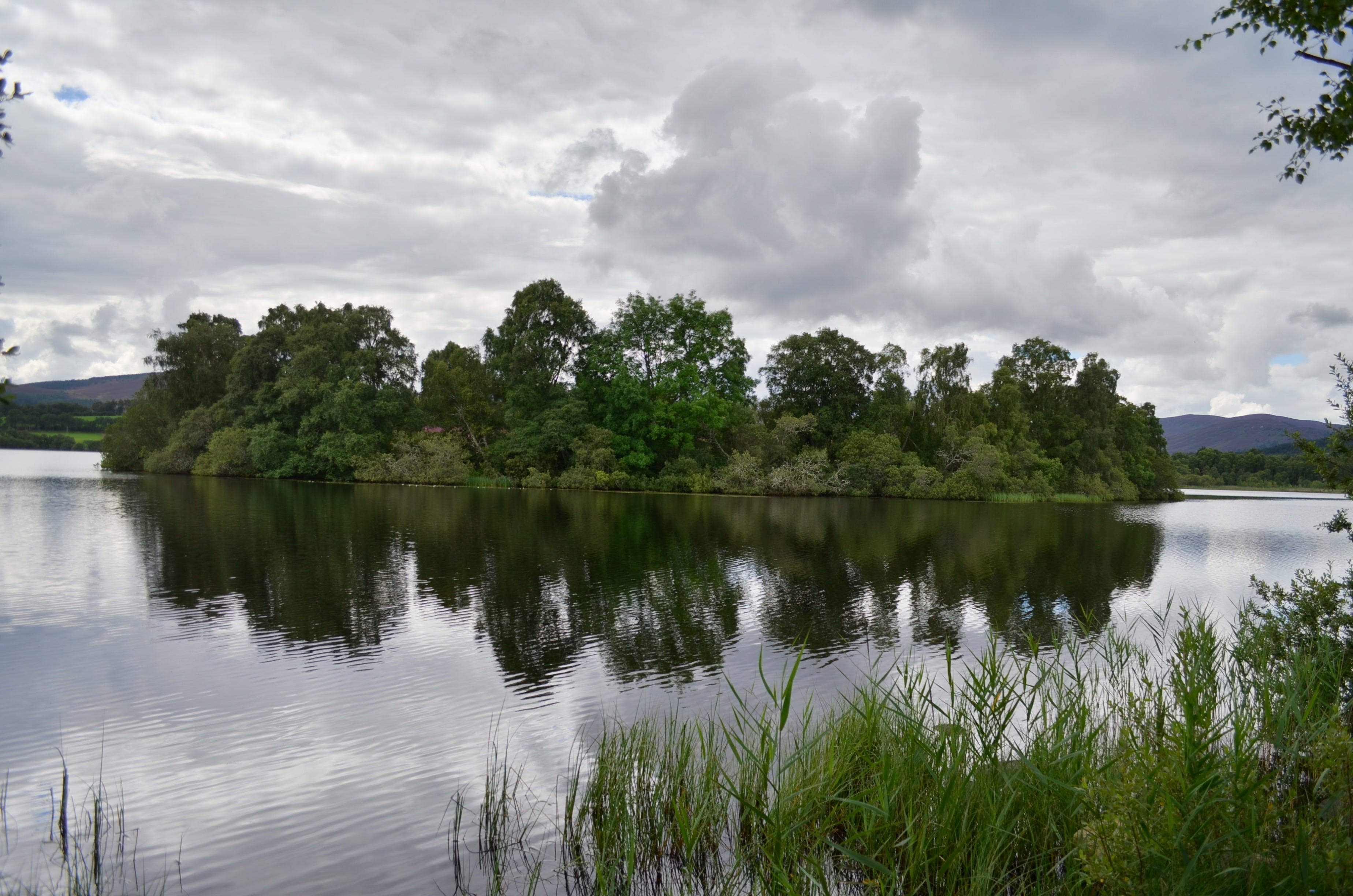
https://commons.wikimedia.org/wiki/File:Loch_kinord_castle_island.jpg
I find it rather appealing that a local tale, dismissed by an early twentieth-century antiquarian as historically confused, might preserve something that the more formal written histories have largely overlooked. Perhaps it is no more than a coincidence. But perhaps, beneath the familiar story of Malcolm Canmore and the Danes, there is a faint recollection of his Norwegian queen and the complicated Scandinavian connections of the eleventh-century Scottish monarchy.
Looking out over the loch, I rather like that possibility.
Further reading
Michie, J. G. (1910). Loch Kinnord: Its History and Antiquities. New and revised edition. Aberdeen.
Ross, A. D. (2007). ‘Moray, Ulster, and the MacWilliams’, in S. Duffy (ed.), The World of the Galloglass: Kings, Warlords and Warriors in Ireland and Scotland, 1200–1600. Dublin: Four Courts Press. Available online.
McDonald, R. A. (1999). ‘Treachery in the Remotest Territories of Scotland: Northern Resistance to the Canmore Dynasty, 1130–1230’, Canadian Journal of History, 33, pp. 161–192. Read online.