
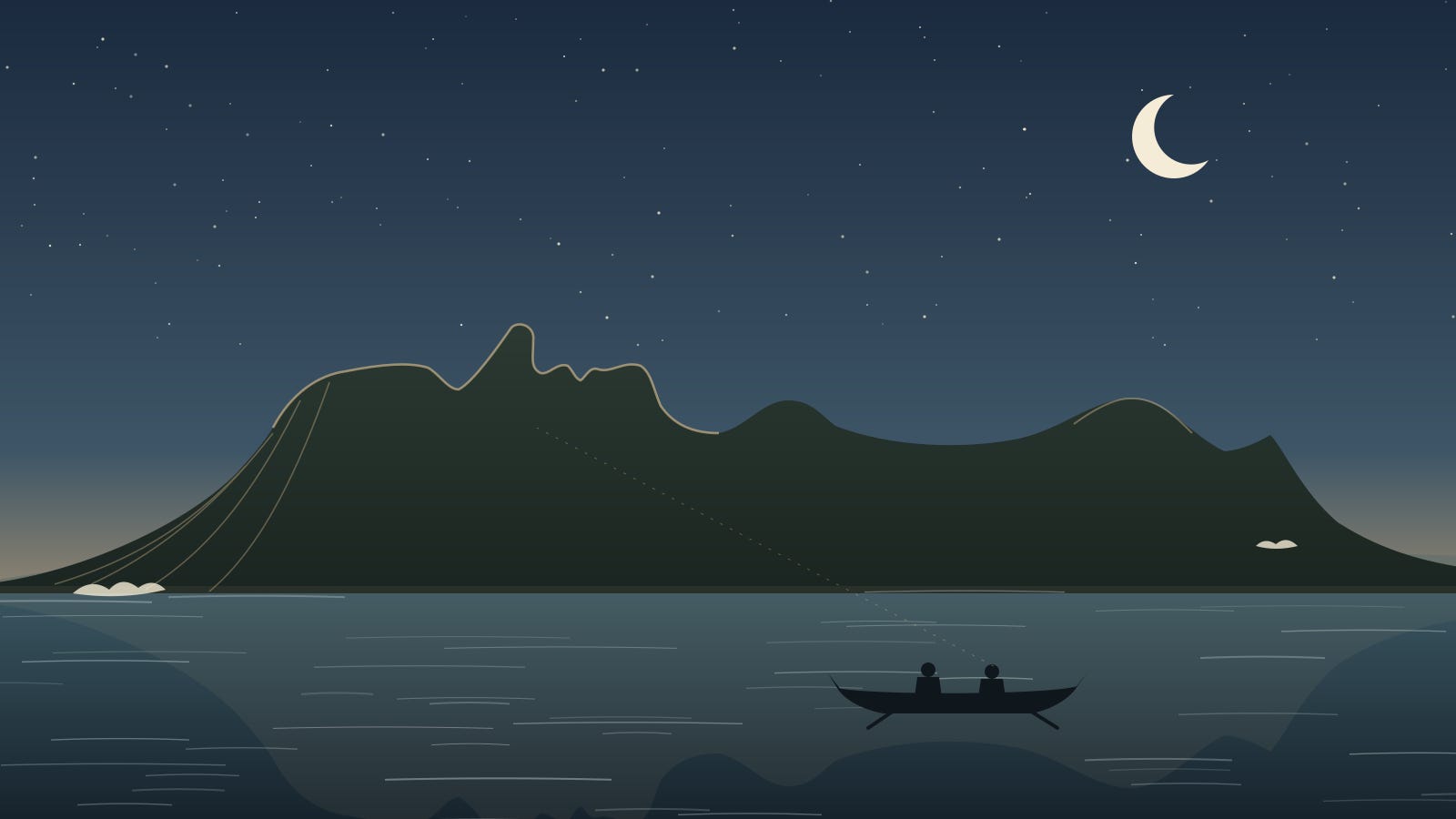
On Burra there is a small hill called Gorewell. Nothing about it would stop a passer-by. I did notice it, but thought nothing of it. It belongs to an ordinary Shetland landscape of fields, shore and well-worn routes, and to most ears its name means nothing at all. Yet hidden in that name is a being of enormous size and power: the Old Norse gýgr, a giantess. Gorewell has been interpreted as gýgjar-hóll, ‘the giantess’s hill’.
When I looked into the place in 2009, Burra folk still knew it as a trowie knowe. One islander remembered being sent there as a child, some thirty years before, to look for trows. Another told me that a generation earlier it had been a place to avoid at night. Nobody I spoke to knew what the name meant, only that the hill had once had supernatural associations.
Because it stands out from the sea, fishermen used it as a meid, one of the landmarks by which they fixed their position. The same modest hill was a point on a working chart of the coast and a home of the uncanny.
In 2010 I wrote a paper for the island studies journal Shima, ‘The Giantess as a Metaphor for Shetland’s Cultural History’, which asked a question Shetlanders still argue about: how much of the islands’ inheritance is Norse, how much Scottish, and how can we tell the two apart? Sixteen years on, the question seems worth asking again, in plainer language and with a little more caution. Up Helly Aa and the Viking helmet offer one answer, loud and lit by fire. The giantess offers a quieter one. Her traces lie scattered in place-names, half-remembered tales and landmarks that most people walk straight past.
Dangerous women of the North
Old Norse literature has no single, tidy giantess. Words such as gýgr and trollkona could describe women who were gigantic, dangerous or uncanny, and the stories told about them pull in different directions. Gerðr, who married the god Freyr, was the fairest of all women. Gjálp, on the other hand in a very different tale, tried to drown Thor in a river of her pee. Most were definitely more frightening than beautiful, immensely strong and closer to wild nature than to the human world. But to picture them all as just ugly monsters would be to miss much of what the sources say.
Some even stood at the head of great families. Skaði, the giantess of the mountains and of skiing, was claimed in the tenth-century poem Háleygjatal as the ancestress of the powerful jarls of Hlaðir in Trøndelag. In 2010 I wondered whether two Shetland names, de braes o’ Skaden and Skadaflekk, might recall her. I would still call that an attractive possibility, but no more than that. Jakob Jakobsen, whose recording of Shetland place-names remains indispensable, offered no etymology for them, though he thought them probably related to the Norwegian personal name Sköðin. A resemblance between names is unfortunately not evidence of a forgotten cult, but one can dream!
The giantess outlived the old gods. Norwegian folklorists were still collecting stories about her in the nineteenth and early twentieth centuries, though by then she was as much a figure of fun as of fear. In a tale from Hordaland she tries to close Hardangerfjord to St Olaf by dragging an island across it, and when that fails she hurls a great stone after him. In another, from Ringerike, she wagers that she can bridge a fjord before Olaf finishes his church. She hears the church bells while her bridge is only half built, pelts the church with stones, and finally tears off her own leg and throws that too; it is said to lie stinking in a bog to this day. These are stories about the conflict between old belief and new, but they are also a way of reading a landscape. A strangely placed rock becomes memorable once someone with a temper has hurled it there.
A giantess in the hill
Jakobsen found that the word gýgr survived in the dialect as gør, used in Unst for an unusually tall, masculine woman and, oddly, for a big snowman. Words do not die necessarily with the languages that made them. They can linger, take on new meanings, or harden into names that no longer make sense to the people who use them every day.
Geurwall, in Aithsting, is another ‘giantess’s hill’, and here there is a story too. John Nicolson recorded it in 1920. Tirval o’ Stivva, passing the trowie knowe, heard music coming from inside the hill. He had a good ear, mastered the tune, and that night played it as the first reel at the gathering he was bound for, to the delight of the company. There is no giantess in the tale; it is about trows, hidden music and the mysterious origin of a human performance. But the name of the hill points back to an older occupant. As at Gorewell, name and story preserve different layers of the island imagination.
Other names belong to the same family. The Guens, from gýgrin, ‘the giantess’, are rugged sea-rocks near the Skerries, best seen from the ferry. Goorn on Fair Isle, a prominent headland just north of Sheep Rock, has the same origin. Jakobsen recorded more, including de stakk o’ Gørasten on Fetlar and a stone called de Gør at Mossbank, and he missed at least two: Geubery on Papa Stour and da Goorl Knowe at Voe. Orkney has its own, at Gorey’s Saddle on the Calf of Eday and Gorie’s Bight at Marwick Head. In Tingwall, the Gew Stanes stand in a bleak spot at the top of the road from Girlsta to Stromfirth, close to two lochs, Tirsawater, from Old Norse þurs, ‘giant’, and Trollawater. It would be fascinating to know what the old tales of that place had to say about such a crowd of monsters. Only the names remain.
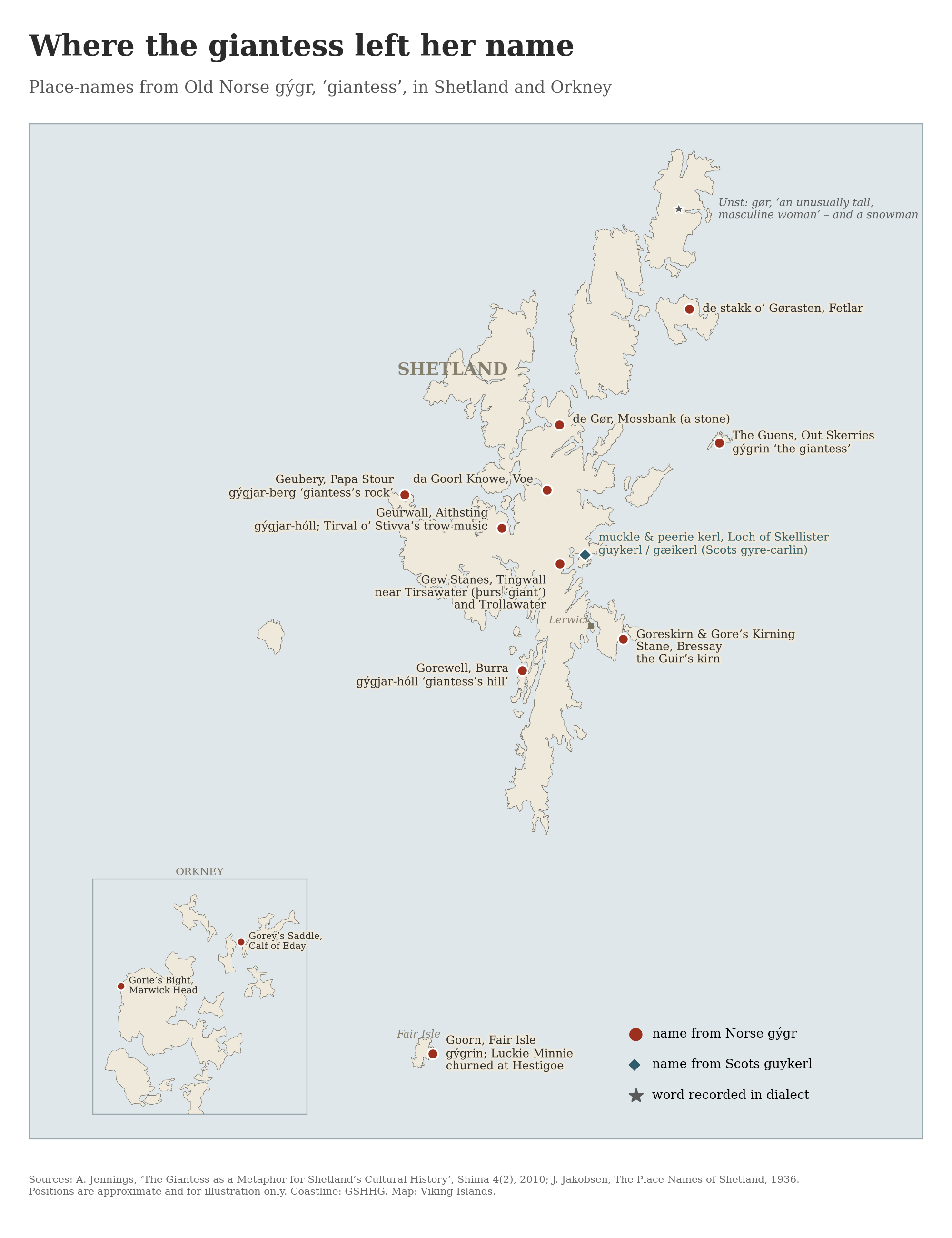
Where the giantess left her name: place-names from Old Norse gýgr in Shetland and Orkney. Positions are approximate.
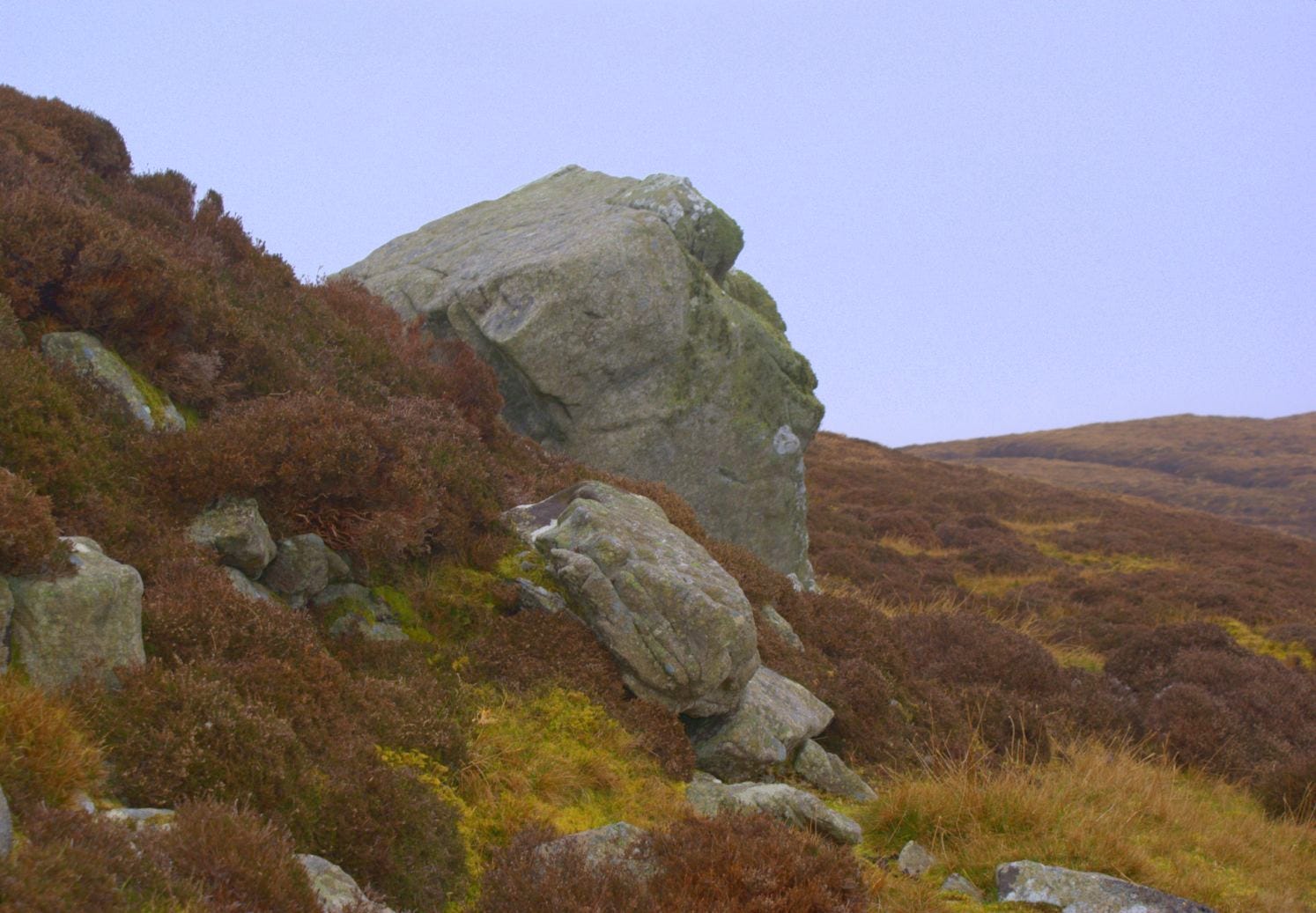
The Gew Stanes.
Sometimes, then, we have a story; sometimes only a name; occasionally, as at Gorewell, both. We can’t force them into a single neat chronology. They show that cultural memory is uneven. A word, a tale and the habit of avoiding a hill after dark can each have a different lifespan.
Luckie Minnie and the churning sea
At the coast the giantess comes into sharper focus. The giantess of Goorn may once have been one of Fair Isle’s four trows, Grotti Finnie, Luckie Minnie, Tushie and Tangie, whose names Ernest Marwick recorded. In his story Luckie Minnie, chasing a troublesome small boy, slipped in a burn and fell into Hestigoe, a geo that fills with white spume. People used to say the spume was Luckie Minnie churning. The restless water was not merely the setting of the story; it was the evidence for it.
Marwick himself noticed that Grotti Finnie and Luckie Minnie recall Fenja and Menja, the two giantesses of Norse myth. Luckie Minnie also means ‘granny’ in Scots, which may simply show how the name was reshaped when Fair Isle’s language changed from Norn to Scots. In Snorri Sturluson’s thirteenth-century Edda, Grótti is the magic mill of King Fróði of Denmark, which will grind out whatever is asked of it but which no one can turn. Fróði buys Fenja and Menja to work it, and they grind out gold, peace and plenty, until, denied any rest, they grind out an army instead. The sea-king Mýsingr kills Fróði, carries off mill and giantesses, and sets them grinding salt. He never tells them to stop. The ship sinks, the sea turns salt, and a whirlpool forms where the water falls through the hole in the millstone. One version of the text places the mill at the bottom of the Pentland Firth, and Judith Jesch has argued that this form of the myth could have taken shape in the medieval earldom of Orkney, of which Shetland was then a part. Grotti Finnie and Luckie Minnie are memories of Fenja and Menja.
A supernatural female grinding or churning, was also remembered in Bressay. At the back of the island are the Goreskirn and the Gore’s Kirning Stane. Until it collapsed in 1933, the Kirn was a funnel-shaped sea-cave that looked like a churn. Writing in the New Shetlander in 1980, Elizabeth J. Smith recorded the tradition that the Evil One, or Guir, stood with one foot on Anderhill and the other on the Wart and churned there, the rhythmic thumping of the waves sounding like a giant at the kirn. The giantess might have changed sex, but the name, the water and the action have outlived the change in her character. This is the only case I have found, so far, in which the gýgr was still remembered in Shetland as a gigantic supernatural being into the late twentieth century.
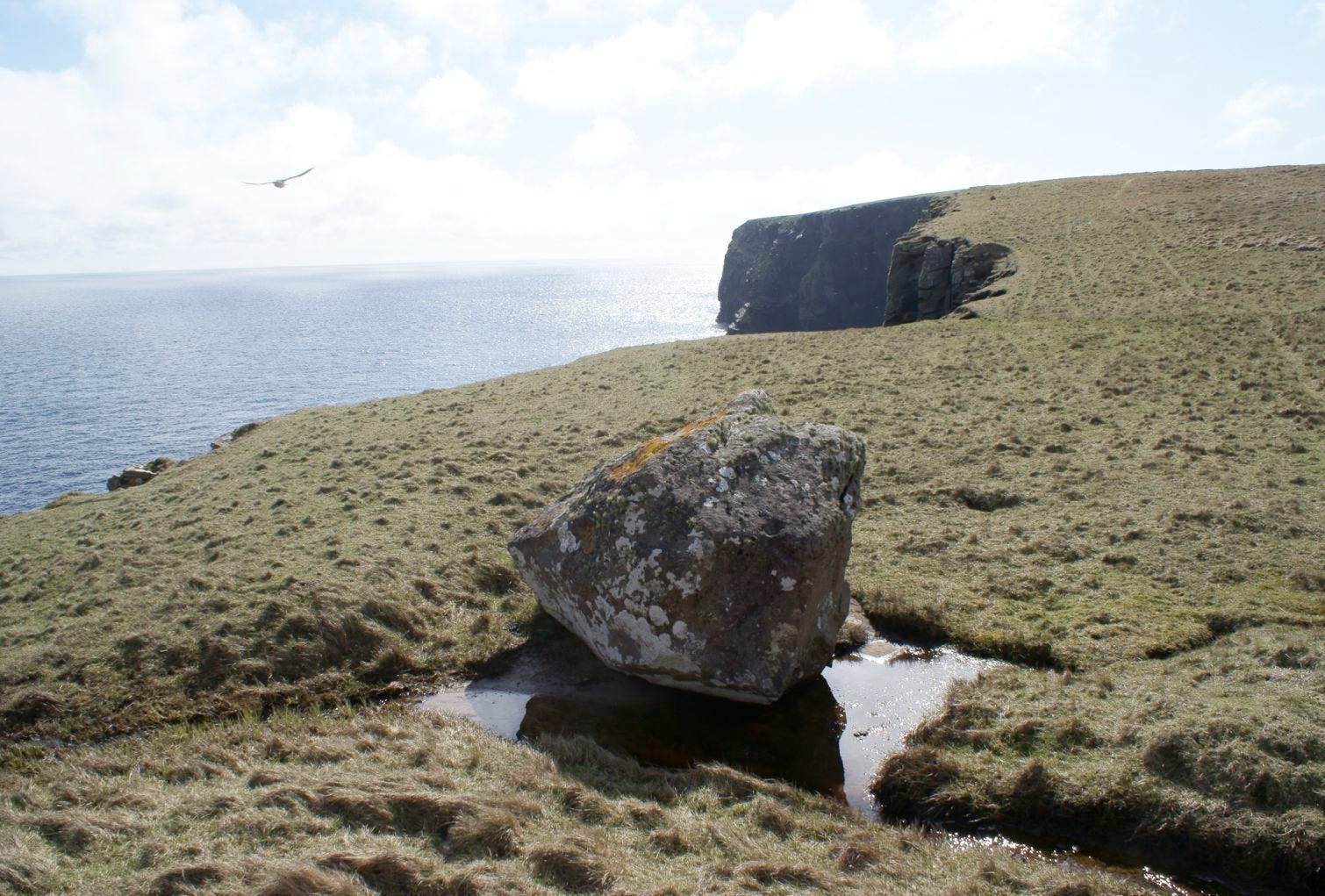
The Gore’s Kirning Stane
The giantess comes back from Scotland
None of this makes Shetland a simple case of one culture surviving the arrival of another. Centuries of contact, migration and language change reshaped both the names of supernatural beings and the stories told about them. As Alan Bruford pointed out, many of Shetland’s trow stories belong to Scottish legend types, often strikingly like stories from Gaelic tradition, even though the word trow comes from Norse troll. A word can be Norse without every story attached to it being Norse as well.
The giantess complicates matters further, because she reached Shetland twice. Lowland Scotland knew her as the gyre-carlin, a name built from two Norse words, gýgr and kerling, ‘old woman’. Walter Scott has ‘worricows and gyre-carlins’ haunting the walls at evening in The Antiquary. Robert Cromek, writing in 1810, calls her ‘the mother of glamour, and near a-kin to Satan himself’, and says she presided over the Hallowmass Rades, the Scots version of the Wild Hunt, when the dead and the fairy host were thought to ride headlong through the night sky, sweeping up anyone unwise enough to be out of doors. Mothers kept their children in line by threatening to hand them over to her, which, with Halloween almost upon us, may be worth bearing in mind!
The peasantry may have had good reason to fear the gyre-carlin, but the poets were not so easily daunted. An anonymous burlesque poem, copied into the Bannatyne Manuscript in 1568, credits her with the making of Berwick Law: she farted it out. Like her Norwegian cousins she reshapes the landscape, if by rather less dignified means, and Gjálp would have recognised the method. Having relieved herself, she rides off across the sea on the back of a pig. Even in Renaissance Edinburgh, the old giantess was still moving the scenery about.
When Scots settlers began arriving in Shetland after 1469, they brought the gyre-carlin with them, and she became the guykerl or gay-kerl. In Jessie Saxby’s collection, Sigger the giant comes to grief chasing his wife the guykerl down a hill. Yet she left few marks on the map: Jakobsen recorded a kerl and a gæikerl in Nesting, probably the two odd rocks now called the muckle and peerie kerl in the Loch of Skellister.
The most revealing tale involves a boy, an enormous old woman and a store of meal. In a version told to Laurence Williamson of Mid Yell in the nineteenth century, a hungry boy’s little bannock rolls out of the door and into a hole in a knoll. Digging down after it, he finds a great big blind gay-kerl sifting meal. He fills his breeks with it, comes back for more, and is caught by the little finger. A giant comes home, sniffing out ‘da eir o a earth man’. The gay-kerl fattens the boy for the pot, but he tricks her into the cauldron instead. The story has the familiar shape of the international tale of the children and the ogre, best known from Hansel and Gretel. Yet it also shares motifs with a Faroese story from Sandur on Sandoy, in which a blind giantess living in Gívrinarhol, ‘the giantess’s cave’, is robbed of her gold. And that giantess grinds her gold on a mill, which takes us straight back to Fenja and Menja.
Which came first? There is no simple answer. The Shetland telling is a meeting place of widespread folktale motifs, local dialect and northern island material. When Alan Bruford recorded the story from the great storyteller Tom Tulloch in 1975, the word guykerl had gone, leaving only a ‘graet big owld wife’. The character is still recognisable; the words that named her have changed again. In a history built from language and storytelling, that kind of change is evidence in its own right.
What the names remember
Why do the names matter so much? Not because they are pristine recordings from the Viking Age. Place-names can be misheard, altered and reinterpreted, and every etymology has to be argued rather than simply declared. But names often outlast the stories attached to them. Norn has long since ceased to be the language of Shetland, yet it survives in the names of fields, rocks, slopes and headlands.
The pattern is clearest where an old, opaque name sits alongside a later and more intelligible legend. At Gorewell the giantess survives in the name, the trows in local memory, and the hill itself in the working knowledge of fishermen. At Geurwall a giantess-name has acquired a story about musical trows. On Bressay the force of the sea was given a supernatural explanation, even as the identity of the churner shifted. None of this is tradition failing. It is tradition in use.
It is also why the question of whether Shetland is ‘really’ Norse or ‘really’ Scottish never quite satisfies. The islands’ culture was made through centuries of movement across the North Sea and through change within the islands themselves. Words endure unevenly. Stories cross linguistic frontiers. Even the Scots giantess who came north after 1469 carried a Norse name. Islands do not simply keep relics for the mainland to sort and label; they make cultural combinations of their own.
In 2010 I argued that, where the giantess is concerned, Shetland’s tradition is primarily Norse, with a Scottish admixture. The place-name evidence still persuades me of that. The giantess has not quite gone. She is there in the names of rocks and hillocks, in the churning of water in a geo, in music heard inside a knowe, and in a child sent up a hill to look for trows. Sometimes she has become an old wife, sometimes even a frightening man; sometimes she has slipped away altogether and left only her name.
A visitor walking past Gorewell would see an ordinary hill. That is exactly what makes it interesting. Its name commemorates a figure who carried a great deal of the Norse imagination: the wild world beyond the farm dyke, the raw power of the land and sea, the realm of creation and death, and a female strength that even the gods had to reckon with. The first Norse settlers brought her with them and set her in the hills and on the cliffs of their new home. The Scots brought another version of her and more than a thousand years later, long after Norn has fallen silent, she is still there, hiding in a place-name.
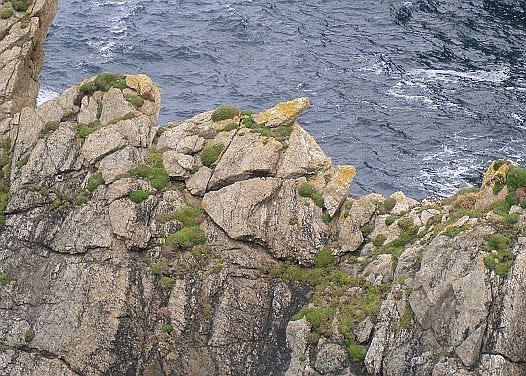
The Trollkonastack with its sleeping giantess.
Author’s note: This essay is a newly written adaptation of my peer-reviewed article ‘The Giantess as a Metaphor for Shetland’s Cultural History’, Shima: The International Journal of Research into Island Cultures, 4(2), 2010, pp. 1–14. The original contains full references and a fuller discussion of the sources, and is freely available at shimajournal.org.
Sources and further reading
The Bannatyne Manuscript, compiled by George Bannatyne, 1568. Glasgow: Hunterian Club, 1896. The burlesque poem in which the gyre-carlin makes Berwick Law.
Bruford, Alan (1997) ‘Trolls, Hillfolk, Finns, and Picts: The Identity of the Good Neighbours in Orkney and Shetland’, in Peter Narváez (ed.), The Good People: New Fairylore Essays. Lexington: University Press of Kentucky, pp. 116–141. Why Shetland’s trow stories look Scottish and Gaelic.
Bruford, Alan and MacDonald, Donald A. (eds) (1994) Scottish Traditional Tales. Edinburgh: Polygon. Tom Tulloch’s tale of the ‘graet big owld wife’ (pp. 45–47).
Craigie, William A. (ed.) (1896) Scandinavian Folk-Lore: Illustrations of the Traditional Beliefs of the Northern Peoples. Paisley: Alexander Gardner. The Faroese giantess of Gívrinarhol, Sandoy (pp. 77–78).
Cromek, Robert H. (1810) Remains of Nithsdale and Galloway Song. London: Cadell and Davies. The gyre-carlin and the Hallowmas rides.
Espeland, Anton (1933) Segn og Soge fraa Hordaland. Skien: Norsk folkekulturs forlag. The Hordaland giantess and St Olaf.
Faye, Andreas (1833) Norske Folke-Sagn. Christiania. The Ringerike giantess who threw her leg at the church.
Jakobsen, Jakob (1936) The Place-Names of Shetland. London and Copenhagen: David Nutt and Wilhelm Prior. The gýgr names, gør in Unst, Skaden and Skadaflekk, and the Nesting kerl.
Jennings, Andrew (2010) ‘The Giantess as a Metaphor for Shetland’s Cultural History’, Shima: The International Journal of Research into Island Cultures, 4(2), pp. 1–14. The full argument, with references; freely available online.
Jesch, Judith (2006) ‘Norse Myth in Orkney’, paper given at the 13th International Saga Conference, Durham and York. Grótti in the Pentland Firth and the earldom of Orkney.
Johnson, L. G. (1971) Laurence Williamson of Mid Yell. Lerwick: The Shetland Times. The guykerl and the tale of the boy and the meal.
Marwick, Ernest W. (1975) The Folklore of Orkney and Shetland. London: Batsford. Fair Isle’s four trows, Luckie Minnie at Hestigoe, and Fenja and Menja.
Moar, Paul (2026) Shetland’s Trolls and Giants. A recent illustrated guide to Shetland’s troll and giant sites, including Troll Kona Stack.
Nicolson, John (1920) Some Folk-Tales and Legends of Shetland. Edinburgh: Thomas Allan and Sons. Tirval o’ Stivva and the music in the hill.
Ó Crualaoich, Gearóid (2003) The Book of the Cailleach: Stories of the Wise-Woman Healer. Cork: Cork University Press. The Cailleach in Gaelic tradition.
Saxby, Jessie M. E. (1932) Shetland Traditional Lore. Edinburgh: Grant and Murray. Sigger the giant and his wife the guykerl.
Scott, Walter (1816) The Antiquary; ed. David Hewitt, Edinburgh: Edinburgh University Press, 1995. ‘Worricows and gyre-carlins’.
Smith, Elizabeth J. (1980) ‘Disappearing Landmarks: Da Guir’s Kirn’, The New Shetlander, Hairst issue, pp. 34–35. The Gore’s Kirn on Bressay.
Snorri Sturluson, Edda, trans. Anthony Faulkes. London: Everyman, 1987. Grótti, Fenja and Menja, Gerðr, Gjálp and Skaði.
Fascinating. I can immediately contribute a couple more potential gýgrs in Orkney. On the low promontory of Cumminess in Stenness, near the Brig o Waithe, is a prominent mound called Gorrie Knowe. And on Stronsay, in the Everbay area, is a croft called Gorries.