
Welcome to my new Substack exploring the Vikings in the North Atlantic Islands! You can receive the occasional free post if you want, or if you feel like subscribing, I’ll be adding longer, more detailed posts for members.
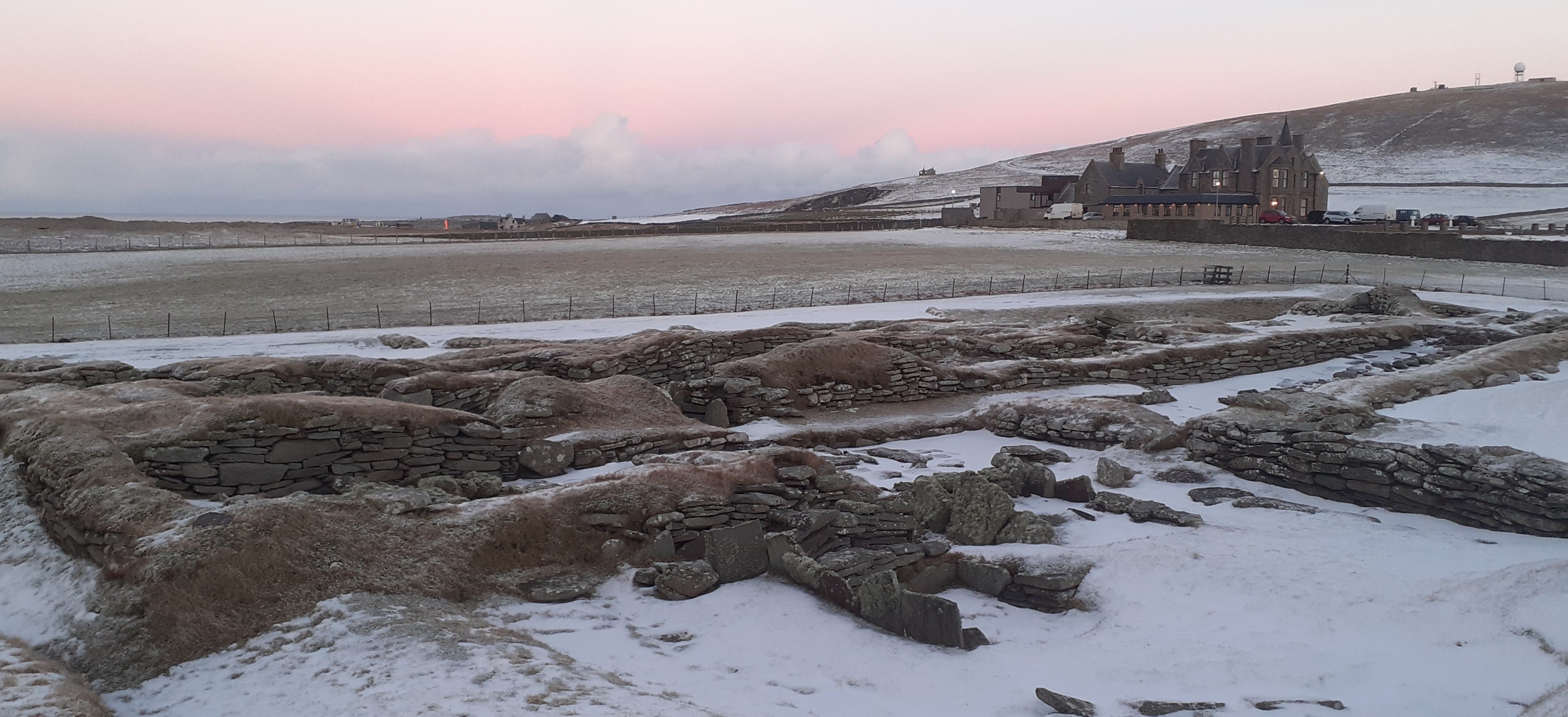
For my first post, I wanted to start with a place that isn't just a historical curiosity, but a part of my daily landscape. I’m incredibly lucky to live just a ten-minute drive from Jarlshof, one of the most remarkable archaeological sites in Europe, and it feels only right to begin our journey here.
To stand at Jarlshof is to stand in several worlds at once. Perched on the southern tip of Shetland's mainland, battered by the North Sea wind, this single headland holds over 4,000 years of human history. It's a place where you can literally walk from a Bronze Age smithy to an Iron Age broch, past Pictish wheelhouses, and straight into the heart of a Viking settlement.
What makes Jarlshof so special is not just the sheer span of time it represents, but the intimate glimpse it offers into the lives of the people who called this place home. The acidic soil of Shetland means that organic materials rarely survive, so the stories are told through stone, bone, and the faint traces of everyday life.
The excavations at Jarlshof have unearthed a treasure trove of artifacts that paint a vivid picture of the past. In the Bronze Age settlement, archaeologists found not only the remains of oval houses with thick stone walls but also a smithy, with broken molds for axes, knives, and swords, evidence of a skilled craftsman trained in what seems to be the Irish style. An extraordinary decorated bone plaque, its purpose still a mystery, was also discovered here.
The Iron Age is represented by the imposing remains of a broch, a defensive stone tower, and a complex of wheelhouses. It is in the later Pictish period that we find some of the most intriguing finds, including a painted pebble and a fragmented incised slab bearing a serpent, offering a tantalizing glimpse into their artistic and symbolic world. (See https://doi.org/10.9750/PSAS.148.1273)
But for me, it's the Viking settlement that truly captures the imagination. Jarlshof is the largest visible Viking site in Britain, with the remains of a longhouse that was home to generations of Norse settlers. Excavations have revealed a wealth of everyday objects: bone pins and awls, loom weights and spindle whorls, and even a slate with a incised Viking ship and another with a beautifully sketched dragon's head. (See https://www.nms.ac.uk/search-our-collections/collection-search-results?entry=161746) Both Picts and Vikings liked serpentine monsters! They had that in common! These are not the treasures of kings, but the humble possessions of a farming and fishing community, a tangible link to their daily lives.
The story of Jarlshof doesn't end with the Vikings. A medieval farmstead and a 16th-century laird's house, the "Jarlshof" of Sir Walter Scott's novel "The Pirate," complete this incredible historical timeline.
Living so close to Jarlshof is a constant reminder that the past is never truly gone. It's a place that invites you to wander, to imagine, and to connect with the thousands of years of human history that have unfolded on this dramatic and beautiful corner of Shetland.
I hope you'll join me as I explore more of the stories that these islands have to tell. Subscribe to stay updated on our journey through the Viking islands. I’ll post a more detailed account of Jarlshof for subscribers.